Which is better: AC or DC fans for solar-powered off-grid use?
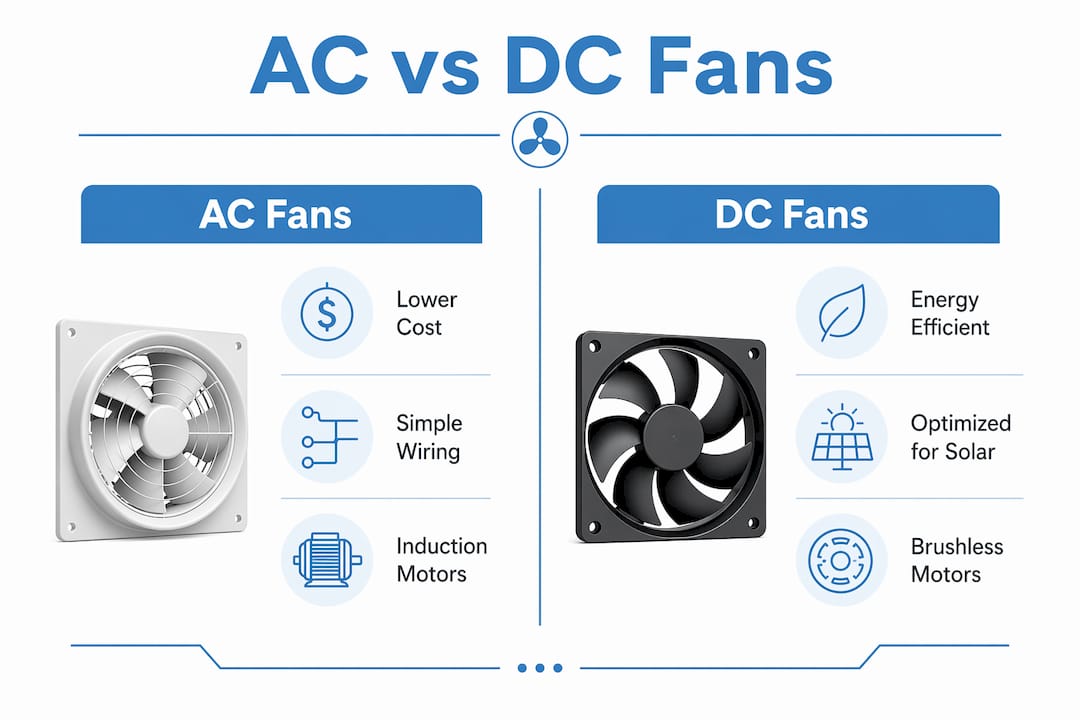
For barns, greenhouses, and workshops running on solar power, DC fans are the clear choice. They consume 40–70% less energy than AC fans at equivalent airflow, which directly shrinks your solar panel and battery requirements. That efficiency gap is the single biggest reason off-grid operators make the switch.
Here is what separates the two technologies in practice:
- Energy draw: DC fans pull far less power, meaning your battery bank lasts longer between charges and your solar array can be sized smaller.
- Noise: DC brushless motors operate 40–60% quieter than AC motors, with quality models often running below 20–35 dB. In a barn or greenhouse, that difference is noticeable all day.
- Speed control: DC fans typically offer 6–12 speed settings compared to the 3-speed standard on AC fans. Finer control means you match airflow precisely to conditions rather than toggling between low, medium, and high.
- Lifespan: Brushless DC motors have no contact wear points. Bearing wear drives failure, not motor burnout, which generally translates to a longer service life under continuous rural duty.
- Total cost: AC fans cost less upfront, but their higher lifetime energy cost and shorter lifespan make them more expensive over time in continuous-use applications.
Key figure: DC fans use 40–70% less power than equivalent AC fans, a gap that directly reduces solar system sizing and battery costs for off-grid operators.
AC fans still make sense in one scenario: low-duty-cycle or intermittent use where simplicity and upfront cost matter more than efficiency. A workshop fan that runs two hours a week does not need a brushless DC motor.
How do Western Harmonics and Super Duty Fans compare?
Two US-based manufacturers stand out for rural and off-grid buyers. Their approaches differ enough that the right choice depends on your specific application.
| Feature | Western Harmonics | Super Duty Fans |
|---|---|---|
| Energy efficiency | DC-only; optimized for solar | AC and DC options available |
| Noise levels | Low; brushless DC motors | Low; patented blade design reduces noise |
| Speed and control | PWM-compatible; solar-integrated control | Multiple speed options; industrial controls |
| Durability and lifespan | Built for continuous rural duty | Texas-built; heavy-duty industrial construction |
| Off-grid solar suitability | Purpose-built for solar; no inverter needed | AC models require inverter; DC models compatible |
| Product range | Solar fan kits, DC micro-power units, microgrid tools | Ceiling, floor, pedestal, wall-mount, HVLS fans |
| Pricing and shipping | Direct-to-consumer e-commerce | Flat-fee shipping included in Continental US |
| Best for | Off-grid agricultural solar ventilation | Industrial barns, workshops, commercial spaces |
| Rating | 3.4★ (17 reviews) | 5★ (5 reviews) |
Western Harmonics is the pioneer of the US solar-powered fan kit category. Every product is engineered around DC power from a solar panel and battery bank, with no inverter required. That matters on an off-grid property: you are not converting DC battery power to AC and then back to DC inside the fan. The energy loss in that double conversion adds up fast. Western Harmonics also offers automated microgrid design tools, which help customers size their solar system correctly before buying hardware.
Super Duty Fans builds industrial-grade fans in Texas, with a catalog that spans ceiling, floor, pedestal, and HVLS models. Their patented blade designs prioritize high airflow volume and quiet operation, and their construction suits demanding environments like manufacturing facilities, hangars, and large barns. Customers who need AC fan options or who are already running a grid-tied or inverter-based system will find more variety here.
How to choose between AC and DC fans for your solar setup
The decision comes down to five practical factors.
- Solar system sizing: Every watt your fan draws is a watt your panels and batteries must supply. A DC fan's lower draw can mean one fewer panel or a smaller battery bank, saving money on the whole system.
- Noise tolerance: Livestock and greenhouse workers spend long hours near running fans. The 60Hz hum from an AC motor is a real fatigue factor over extended periods. DC fans running at low noise levels are far easier to work around.
- Control precision: PWM control in DC fans allows sensor-based automation without the variable frequency drives that AC systems require. For a greenhouse with temperature sensors, that is a meaningful advantage.
- Power source compatibility: DC fans need a regulated DC supply matched to their voltage rating. Battery banks can rise above nominal voltage during charging, so confirm your fan's rated voltage covers that range. Mismatched voltage causes premature failure.
- Total cost of ownership: AC fans cost less at purchase. DC fans cost less to run. For a fan operating eight or more hours daily, the DC payback period is short.
Pro Tip: Use a quality regulated DC power source, not a cheap modified sine wave inverter feeding a DC converter. Low-quality power sources introduce electrical noise that degrades DC fan driver circuits and shortens motor life significantly.
Installation considerations for off-grid and rural settings
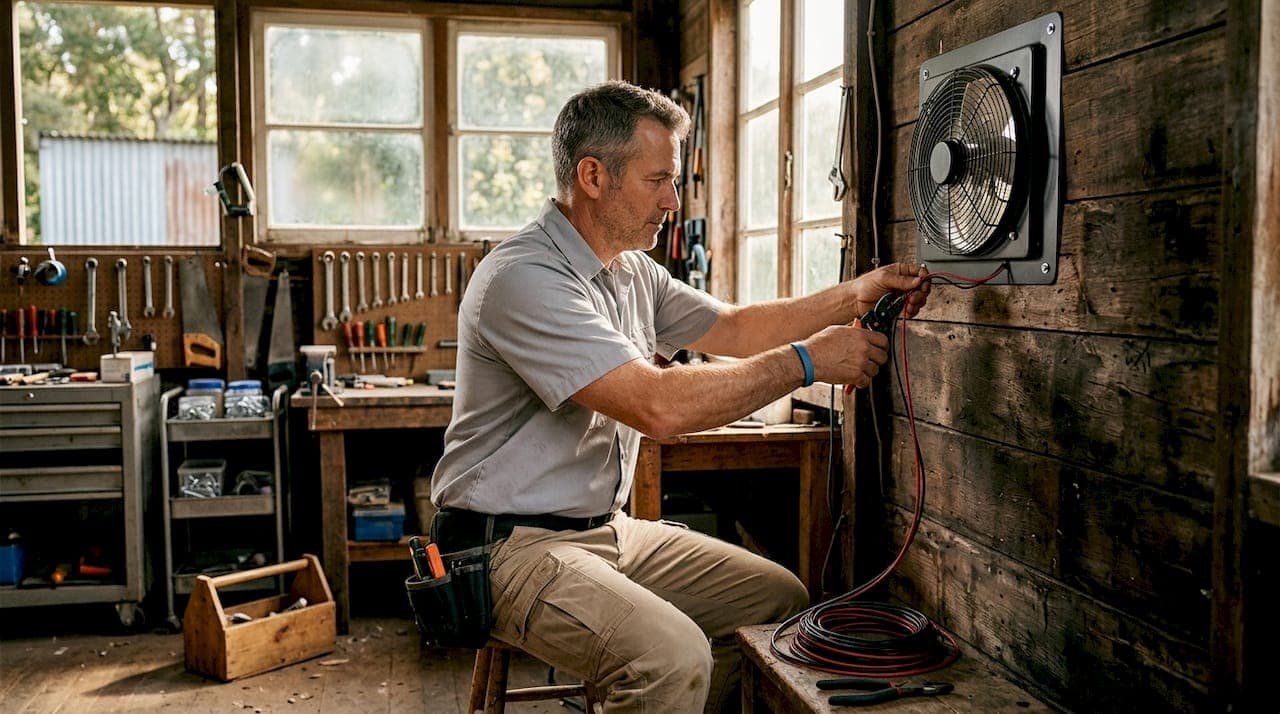
AC fans connect directly to 110V or 220V AC mains. On an off-grid property, that means running an inverter, which adds cost, complexity, and conversion losses. DC fans connect directly to your battery bank or solar charge controller output, keeping the system simple and efficient.

Wiring runs in barns and greenhouses are often long. DC systems at 24V or 48V carry the same power at lower current than 12V systems, which reduces voltage drop over distance and allows thinner wire. Match your fan's voltage to your battery bank nominal voltage, and verify the fan can handle the elevated voltage that appears during active charging.
For off-grid solar setups, a MPPT charge controller paired with a DC fan is more efficient than a PWM charge controller, particularly when panel voltage is significantly higher than battery voltage. The MPPT controller harvests more energy from the panels, which matters when you are running fans continuously through summer heat.
Maintenance and durability under rural conditions
Dust, heat, humidity, and vibration are the real enemies of fan longevity in barns and greenhouses. DC brushless motors have no brushes to wear out, so the main maintenance point is bearing condition. Quality ball bearings in a DC fan handle continuous duty well, but they do accumulate dust. Periodic cleaning of the blade assembly and motor housing keeps airflow consistent and prevents heat buildup in the motor.
AC fans with induction motors are mechanically simple and physically rugged. In a dusty barn environment, that simplicity is an asset. The trade-off is that AC motors run less efficiently and generate more heat internally, which accelerates bearing wear over time. For continuous-duty applications, DC brushless fans outlast AC equivalents under similar conditions.
Safety considerations for wiring AC and DC fans
AC wiring at 110V or 220V carries lethal shock risk. Rural installations often involve long conduit runs through wet or dusty environments, which increases the importance of proper weatherproof connectors, GFCI protection, and correct wire gauge for the load.
DC systems at 12V or 24V are far safer to work with, though high-current DC wiring still demands proper fusing close to the battery. A short circuit in an unfused DC line can cause a fire, particularly in a barn with dry bedding nearby. Always fuse DC fan circuits at the battery terminal, use wire rated for the current draw, and keep connections clean and tight to prevent resistance heating at terminals.
Westernharmonics builds solar fan systems for exactly this
Running fans off a solar panel and battery bank is what Westernharmonics was built to do. We created the US solar-powered fan kit category and have spent years refining systems that work reliably in barns, greenhouses, and workshops without a grid connection or an inverter in the chain.

Our DC fan kits ship with matched solar panels and hardware sized for real agricultural duty cycles. We also offer automated microgrid design tools that help you size your system correctly before you spend a dollar on hardware. If you are ready to stop guessing at panel and battery sizing, explore our solar fan kits and let the tool do the math for you.
Key Takeaways
DC fans outperform AC fans for solar-powered off-grid ventilation on every operational metric: energy draw, noise, control precision, and lifespan under continuous rural duty.
| Point | Details |
|---|---|
| Energy efficiency | DC fans use 40–70% less power than AC fans, directly reducing solar panel and battery sizing requirements. |
| Noise and control | DC brushless motors run 40–60% quieter, often operating below 20–35 dB, and offer 6–12 speed settings versus 3 for AC fans. |
| Installation fit | DC fans connect directly to battery banks, eliminating inverter losses common in AC off-grid setups. |
| Total cost | AC fans cost less upfront but carry higher lifetime energy and maintenance costs in continuous-use applications. |
| Westernharmonics | Purpose-built solar DC fan kits with matched hardware and microgrid sizing tools for barns, greenhouses, and workshops. |