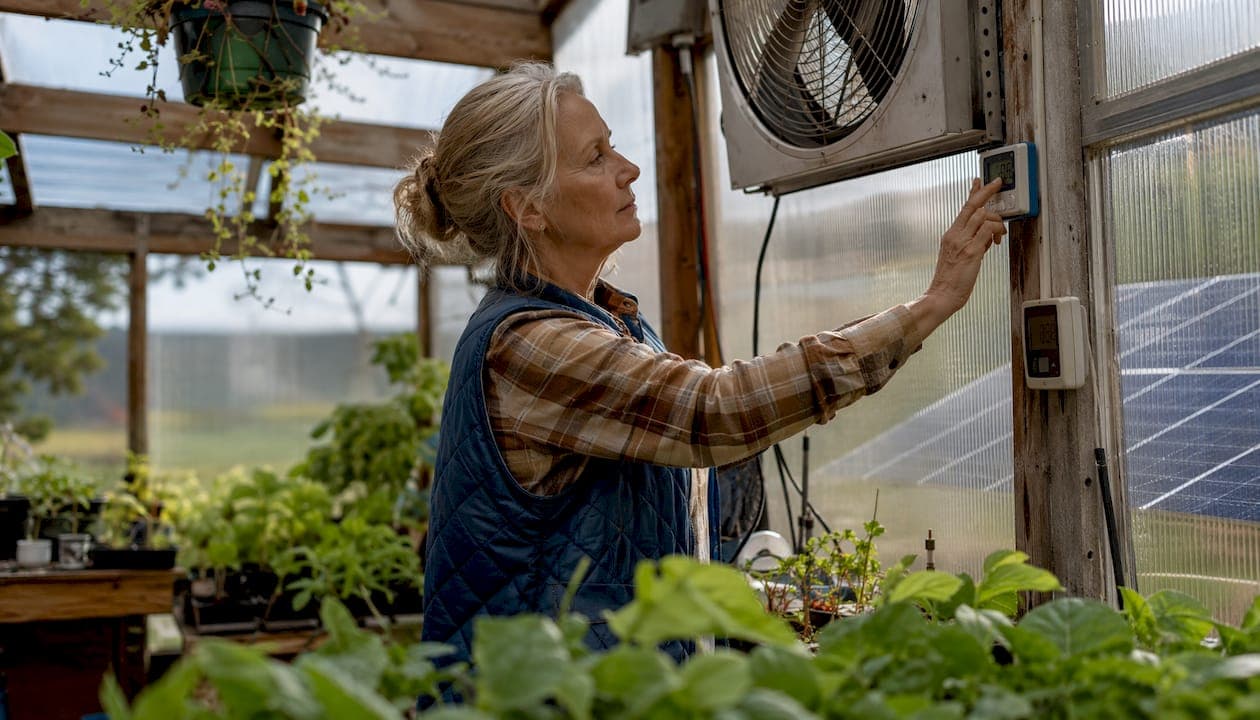
Why greenhouse thermostat control matters for off-grid operators
Greenhouse thermostat control is the automated regulation of temperature and ventilation using thermostats that signal heating, cooling, and fan systems to activate at precise setpoints. For rural and off-grid operators, that definition carries real weight: without reliable grid power, manual adjustments fail at night, on weekends, and during heat spikes that can wipe out a crop in hours.
Solar-powered fan systems solve this directly. They draw power from panels rather than the grid, meaning your ventilation runs when the sun drives temperatures up, exactly when you need it most. Pair that with a well-configured thermostat, and you get automated greenhouse climate control that protects plants around the clock without a utility bill.
Key benefits at a glance:
- Stable microclimate conditions that reduce plant stress and improve yields
- Energy savings from precise temperature cycling instead of wide-swing mechanical control
- Independence from unreliable rural grid power
- Equipment longevity through reduced short cycling of fans and heaters
- NEMA 4X and IP65-rated hardware that survives humidity, dust, and fertilizer mist
Table of Contents
- 1. Mechanical vs. electronic thermostats: which gives you better temperature control?
- 2. What features should you look for in a greenhouse thermostat controller?
- 3. How do you integrate solar-powered fans with your thermostat system?
- 4. Best practices for thermostat placement, programming, and maintenance
- Automated temperature control improves plant health and cuts energy costs
- Energy efficiency techniques for solar-powered fan controls
- Thermostat options available in the U.S. greenhouse market
- Safety and U.S. electrical compliance for greenhouse thermostat systems
- Westernharmonics solar fan kits built for off-grid greenhouse cooling
- Key Takeaways
1. Mechanical vs. electronic thermostats: which gives you better temperature control?
The type of thermostat you choose determines how tightly your greenhouse holds its target temperature, and that gap matters more than most growers expect.
Mechanical thermostats use a bimetallic strip or bellows to sense temperature. They typically operate with a differential of 4–6°F, meaning a heater set to 60°F might not shut off until 64°F and won't restart until 56°F. That wide swing causes excessive cycling, wears out fans and heaters faster, and wastes fuel.
Electronic thermostats use a digital sensing element and hold a differential of roughly ±1°F. Tighter control means fewer on/off cycles, longer equipment life, and measurable fuel savings over a heating season.
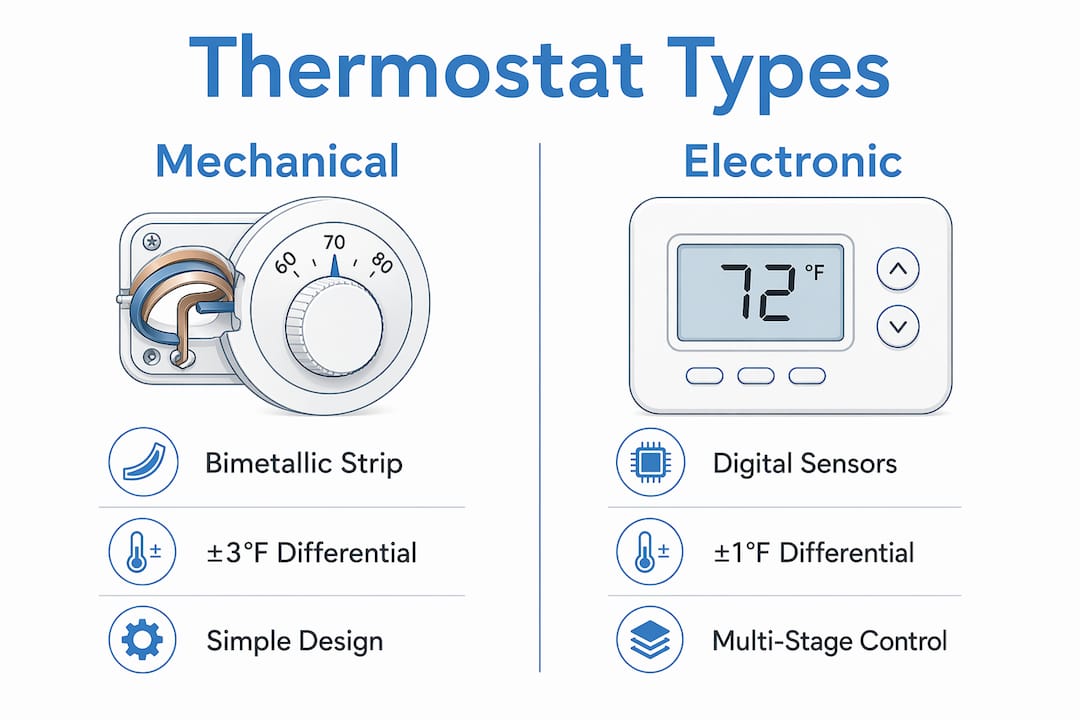
For off-grid solar fan systems, the ±1°F differential is especially valuable. Every unnecessary fan activation draws from your battery bank. Fewer false triggers mean your stored solar energy lasts longer between sun events.
Pros and cons summary:
- Mechanical: low upfront cost, simple wiring, but wide differential and higher long-term energy use
- Electronic: higher precision, energy savings, longer equipment life, better compatibility with multi-stage controls
- Standard home thermostats: not suitable for greenhouses; humidity and dust cause rapid failure in unsealed units
2. What features should you look for in a greenhouse thermostat controller?
Not every controller built for HVAC work belongs in a greenhouse. The environment is harsher, the stakes are higher, and the control logic needs to match how plants actually grow.
Multi-stage control is the most important functional feature. A multi-stage thermostat activates heating and cooling independently, preventing both systems from running at the same time. Simultaneous operation wastes energy and creates unstable conditions. Look for controllers with at least two heating stages and two or more cooling stages.
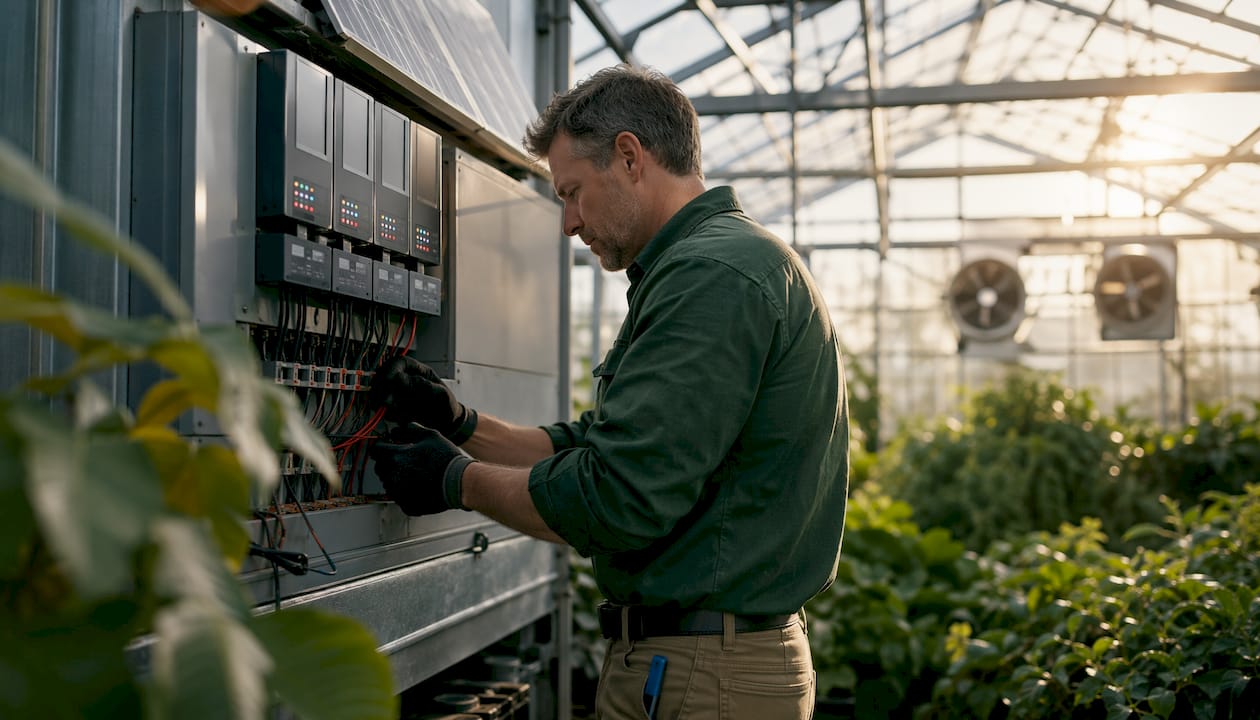
Environmental ratings determine whether your controller survives the job. Greenhouse electronics require NEMA 4X-rated enclosures to resist humidity, water spray, and corrosive fertilizer mist. IP65 is the international equivalent. Standard enclosures fail quickly in these conditions.
Must-have features for greenhouse use:
- NEMA 4X or IP65 enclosure rating
- Multi-stage outputs for independent heating and cooling
- Day/night setpoint programming with photocell or time-clock detection
- Ramping function for gradual transitions between setpoint periods
- Remote or aspirated temperature sensor input
- Analog output (0–10VDC or 4–20mA) for variable-speed fan control
- UL or cUL listing for U.S. commercial installations
- Data logging and alarm outputs for temperature and power failure
Controllers like the Wadsworth STEP Up and EnviroSTEP offer these features with UL listings and solar-guarded aspirated sensor compatibility, making them well-suited for commercial U.S. greenhouse operations. For smaller pad-and-fan setups, the Link4 Pearl Prime provides IP65-rated environmental control with cloud monitoring and integrated power relays.
3. How do you integrate solar-powered fans with your thermostat system?
Pairing a thermostat with solar-powered fans requires matching control signals, sensor placement, and power sizing. Get these three right, and the system runs itself.
Westernharmonics pioneered the solar-powered fan kit market in the United States and builds DC micro-power units and ventilation hardware specifically for off-grid environments like greenhouses, barns, and rural workshops. Their systems are designed to accept control signals from standard thermostat outputs, so integration with a greenhouse controller is straightforward.
How the signal chain works: the thermostat sensor reads air temperature, compares it to your setpoint, and sends a switched or analog signal to the fan controller. The solar fan activates, moves air, and the thermostat monitors until the setpoint is satisfied. No grid connection required at any point in that loop.
Integration tips:
- Match the thermostat's output signal type (switched relay vs. 0–10VDC analog) to your fan controller's input
- Size your solar panel and battery bank to cover peak ventilation demand during the hottest part of the day
- Use DC fans rated for continuous duty to handle the thermal load without overheating
- Place the temperature sensor away from direct sun and heat sources for accurate readings
- Run sensor cable and power wiring in separate conduits to avoid signal interference
- Select fan hardware with sealed motors rated for dusty, humid greenhouse air
Advanced climate systems can also integrate humidity, CO2, and lighting into a single controller, which prevents humidity spikes and disease pressure during cooling cycles. For most off-grid operators, starting with temperature and ventilation control delivers the largest return before adding complexity.
4. Best practices for thermostat placement, programming, and maintenance
Where you mount the sensor and how you program the setpoints determine whether your system actually protects your crop or just looks like it does.
Sensor placement: mount your temperature sensor at plant height in the center of the greenhouse. A solar-guarded aspirated sensor draws air across the sensing element continuously, eliminating false high readings from radiant heat. Direct sun on an unshielded sensor can read 10–15°F above actual air temperature, triggering unnecessary cooling and draining your battery bank.
Programming setpoints: use separate day and night setpoints. Night temperatures can typically run 5–10°F lower than daytime targets, which cuts heating demand significantly. The ramping function on controllers like the Wadsworth STEP Up transitions gradually between setpoints rather than stepping abruptly, mimicking natural temperature rhythms and reducing plant stretch.
Pro Tip: For every 1°F of improved temperature accuracy, the U.S. Department of Energy estimates a 3% reduction in energy consumption. A solar-guarded aspirated sensor pays for itself quickly in reduced fan runtime and fuel savings.
Best practice checklist:
- Mount sensor at plant canopy height, center of the growing zone
- Use aspirated, solar-guarded sensor housing
- Set day and night setpoints independently; enable ramping between periods
- Schedule annual calibration checks and clean sensor housings
- Inspect NEMA 4X enclosure seals each season for cracking or moisture intrusion
- Prevent simultaneous heating and cooling with multi-stage controller logic
- Log temperature data and review weekly to catch sensor drift early
Reducing heat loss through the greenhouse envelope also reduces the load your thermostat system has to manage, so insulation and structural sealing work alongside your controls.
Automated temperature control improves plant health and cuts energy costs
Manual temperature adjustments are unreliable. A grower checking the greenhouse twice a day misses the 2 AM cold snap and the 1 PM heat spike. Automated controllers prevent the wide temperature swings that cause plant stress, slowed growth, and disease pressure.
Consistent temperature regulation keeps photosynthesis running at full efficiency. It also prevents the humidity spikes that follow rapid cooling, which are a primary trigger for fungal disease in dense plantings. For off-grid operators, the energy savings compound: precise control means fewer hours of fan and heater runtime, which directly extends the life of your solar battery bank and reduces propane or natural gas consumption.
Energy efficiency techniques for solar-powered fan controls
Efficiency in a solar-powered system starts with reducing unnecessary runtime. A few techniques make a measurable difference:
Use variable-speed fan control via an analog output (0–10VDC). Rather than running fans at full speed whenever the setpoint is exceeded, a modulating controller ramps fan speed proportionally to the temperature deviation. Lower speed means lower current draw and longer battery runtime.
Stage your cooling equipment. Run exhaust fans first, then activate evaporative cooling or additional fan banks only if temperature continues to rise. This staged approach, standard on multi-stage controllers, prevents the full electrical load from hitting your solar system simultaneously.
Reducing energy loss through gaps, vents, and poorly sealed glazing reduces the cooling load your fans have to overcome. Less heat entering the structure means shorter fan runtimes and a smaller solar panel requirement.
Thermostat options available in the U.S. greenhouse market
Several controllers are well-established in the U.S. market for greenhouse use:
Wadsworth STEP Up and EnviroSTEP are purpose-built greenhouse controllers with UL listings, multi-stage outputs, ramping, day/night/DIF setpoints, and solar-guarded aspirated sensor compatibility. The EnviroSTEP scales to 100 zones and supports analog outputs for variable-speed fans.
Senasys line voltage thermostats and two-stage controllers offer NEMA 4X enclosures, UL and cUL approvals, and direct line-voltage switching for simpler installations without additional relays.
Link4 Pearl Prime suits smaller pad-and-fan operations with its IP65 rating, cloud monitoring, and Ethernet connectivity.
Day/night thermostats like the APCET2 from Gothic Arch Greenhouses provide built-in photocell detection and memory-lock setpoints for growers who want reliable day/night control without a full climate computer.
Safety and U.S. electrical compliance for greenhouse thermostat systems
Greenhouse electrical installations in the United States fall under the National Electrical Code (NEC), specifically Article 547, which covers agricultural buildings. Key requirements include ground fault circuit interrupter (GFCI) protection for receptacles in wet locations, proper equipment grounding, and the use of listed equipment for the intended environment.
Controllers and enclosures should carry a UL or cUL listing for commercial use. NEMA 4X enclosures meet NEC requirements for wet and corrosive locations. All wiring in greenhouse environments should use conductors and conduit rated for wet locations, and any 240V equipment must be installed by a licensed electrician in most U.S. states.
Annual inspection of contactors, relays, and sensor wiring catches surge damage and corrosion before they cause equipment failure or safety hazards.
Westernharmonics solar fan kits built for off-grid greenhouse cooling

Off-grid greenhouse operators need ventilation hardware that works without the grid, survives the environment, and connects cleanly to a thermostat controller. That is exactly what Westernharmonics builds. As the original pioneer of the solar-powered fan kit market in the United States, we design DC micro-power units and high-efficiency solar ventilation systems used in greenhouses, barns, and rural infrastructure across the country.
Our fan kits are engineered for rugged, continuous-duty operation in dusty, humid conditions. They accept standard thermostat control signals, so pairing them with the multi-stage controllers covered in this article is straightforward. No grid hookup, no utility bill, no dependency on infrastructure that may not reach your property.
Visit Westernharmonics to see our current solar fan kit lineup and off-grid cooling hardware built specifically for greenhouse and rural applications.
Key Takeaways
Precise greenhouse thermostat control, paired with solar-powered ventilation, gives off-grid operators stable crop conditions and lower energy costs without grid dependency.
| Point | Details |
|---|---|
| Electronic thermostats save energy | A ±1°F differential prevents excessive cycling, cutting fuel use compared to mechanical thermostats with a 4–6°F swing. |
| NEMA 4X/IP65 ratings are required | Standard enclosures fail in greenhouse humidity; sealed ratings protect controllers for long-term reliability. |
| Sensor placement drives accuracy | A solar-guarded aspirated sensor at plant height prevents false readings and unnecessary fan activation. |
| Ramping and day/night setpoints reduce costs | Gradual transitions between setpoints mimic natural rhythms, lower night heating demand, and improve crop quality. |
| Westernharmonics for off-grid cooling | Solar-powered fan kits from Westernharmonics connect directly to thermostat controllers for reliable, grid-free greenhouse ventilation. |