
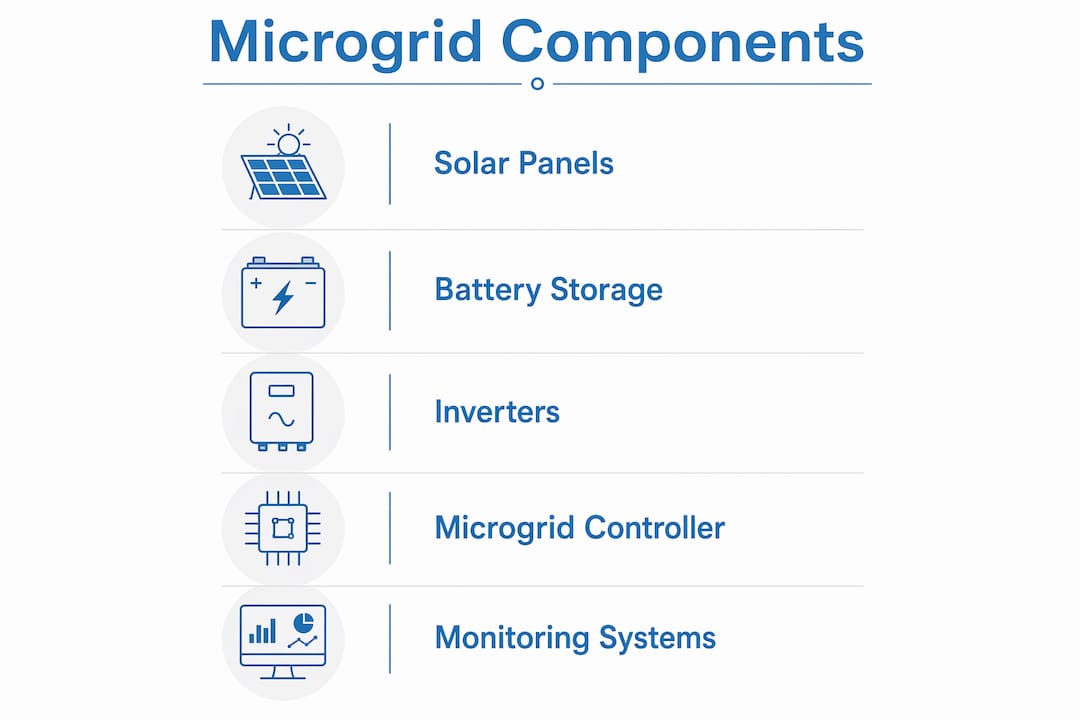
A reliable off-grid microgrid for a barn, greenhouse, or rural homestead depends on six core microgrid components working together: solar panels, battery storage, inverters and converters, a microgrid controller, protection devices, and a communication and monitoring system. According to the U.S. Department of Energy, a microgrid is a single controllable electrical entity capable of operating connected to the grid or fully islanded. For rural operators, that islanded mode is the whole point. Add load management to the mix, and you have a system that can keep cooling fans running in a horse barn during a summer blackout, or maintain greenhouse ventilation when the utility grid goes down for days.
- Solar panels convert sunlight into DC electricity, the primary generation source
- Battery storage holds surplus energy for nights and cloudy periods
- Inverters and converters translate DC power to AC where needed, and regulate voltage
- Microgrid controller coordinates generation, storage, and load in real time
- Protection devices isolate faults and keep the system safe
- Communication and monitoring systems provide visibility and automated response
- Load management ensures critical equipment stays powered when generation is limited
Safety standards such as NEC Article 712 (DC microgrids) and UL 9540 (energy storage) govern how these components are installed and integrated in the U.S.
Table of Contents
- How each microgrid component functions in a rural off-grid system
- How to prioritize loads so your critical systems never go dark
- How Westernharmonics approaches off-grid cooling and microgrid design
- DC microgrid protection: what rural operators need to know
- Key Takeaways
- Westernharmonics makes off-grid power straightforward for rural operators
How each microgrid component functions in a rural off-grid system
Understanding what each part does helps you size and specify your system correctly rather than guessing.
Solar panels for small rural microgrids typically fall into two categories: monocrystalline and polycrystalline. Monocrystalline panels deliver higher efficiency per square foot, which matters when roof or ground space is limited on a working farm. A typical starting point for a barn with ventilation fans and basic lighting is a small solar array sized appropriately for those loads.
Battery storage is where most rural operators underinvest. The DOE notes that battery energy storage typically represents 9–15% of up-front microgrid equipment costs, yet it is the component that determines how many hours of cooling you get after sunset. Lithium iron phosphate (LiFePO4) chemistry has become the practical standard for off-grid agricultural use because of its thermal stability and cycle life. A battery management system (BMS) monitors cell voltage, temperature, and state of charge to prevent over-discharge and extend pack life. For a broader look at home energy storage options, different chemistries carry different trade-offs in cost, weight, and longevity.
Inverters and converters handle the translation between DC and AC. A DC-to-AC inverter feeds standard household or farm circuits; a DC-DC converter steps voltage up or down within the DC bus. In a barn DC microgrid running direct-drive fans, you may not need an inverter at all, which cuts cost and eliminates a conversion loss.
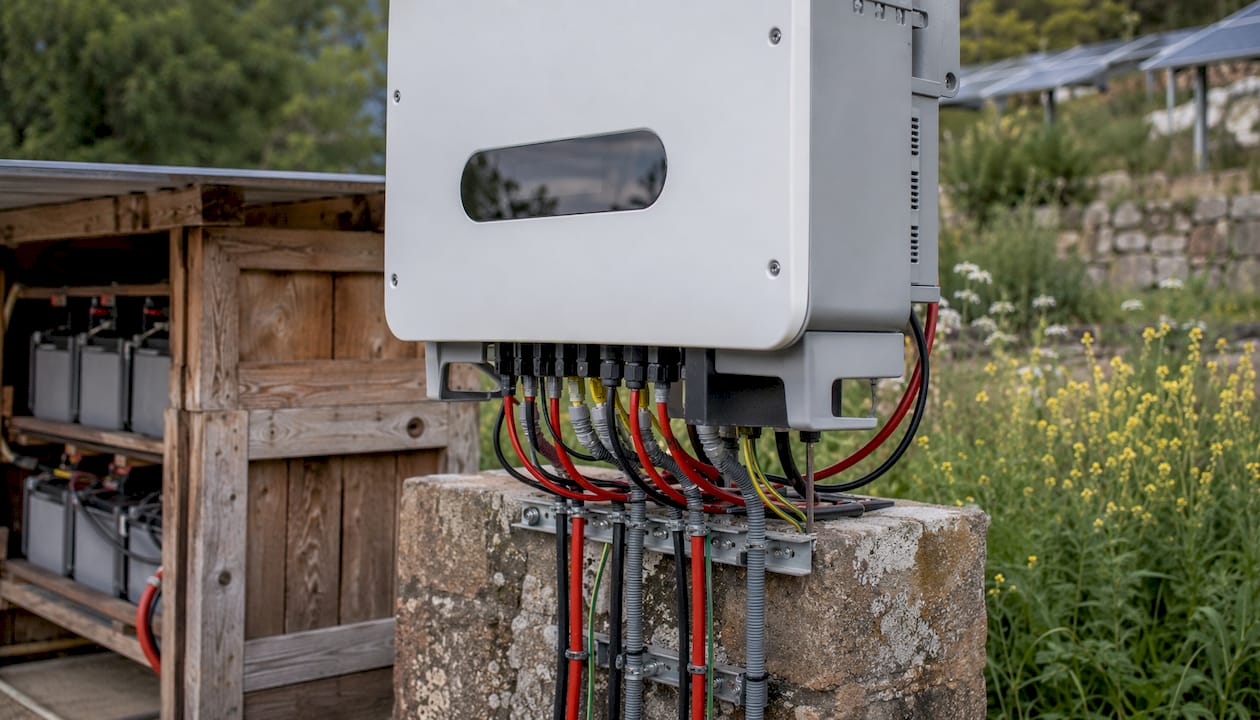
The microgrid controller is the intelligence hub. Per the National Renewable Energy Laboratory, it manages real and reactive power balance, coordinates islanding transitions, and dispatches distributed energy resources to match load. Black start capability, the ability to restart the system independently after a total outage, is a must-have feature for any rural off-grid controller. Without it, a blackout means waiting for utility power to restore before your system can come back online.
Communication and monitoring systems tie everything together. SCADA platforms and modern energy management software give you real-time visibility into generation, storage state, and load draw. The NREL confirms that real-time monitoring enables optimal energy dispatch and timely fault response, both of which matter when your nearest electrician is 45 minutes away.
| Component | Primary Function | Key Spec to Confirm |
|---|---|---|
| Solar panels | DC generation | Efficiency rating, temperature coefficient |
| Battery storage | Energy buffer | Usable kWh, cycle life, BMS included |
| Inverter/converter | Power translation | Continuous wattage, surge rating |
| Microgrid controller | System coordination | Islanding, black start, load dispatch |
| Protection devices | Fault isolation | DC-rated, interrupt capacity |
| Monitoring system | Visibility and control | Real-time data, remote access |
How to prioritize loads so your critical systems never go dark
Load prioritization is where microgrid design gets practical. The Asian Development Bank's microgrid handbook identifies three tiers that translate directly to farm and rural applications.
- Critical loads must never lose power. For agricultural operators, this means ventilation fans in livestock barns, refrigeration for vaccines or perishables, and well pumps. Any interruption here costs money or risks animal welfare.
- High-priority loads can tolerate brief interruptions but should be restored quickly. Greenhouse heating, irrigation controls, and workshop lighting fall here.
- Low-priority loads are shed first when generation is limited. Convenience outlets, battery chargers for non-essential equipment, and secondary lighting are typical examples.
The controller enforces these tiers automatically. When solar production drops on a cloudy afternoon and battery reserves fall below a set threshold, low-priority loads disconnect first. Critical loads stay on. This is not a manual process once the system is configured correctly.
Pro Tip: Schedule high-draw tasks like water pumping or grain auger operation during peak solar hours (roughly 10 AM to 2 PM). Pre-cooling a barn or greenhouse before the hottest part of the day reduces the load during low-generation evening hours and stretches your battery reserve further.
How Westernharmonics approaches off-grid cooling and microgrid design
Westernharmonics built the solar-powered fan kit category in the United States before most competitors knew the market existed. The focus has always been engineering simplicity: fewer components, less to fail, more reliable airflow in the places that need it most.
Our DC micro-power units and solar ventilation systems are designed specifically for barns, greenhouses, and rural workshops where running grid power is expensive or impractical. The hardware is built to handle dust, heat, and the kind of daily abuse that comes with agricultural environments. That means sealed motors, UV-resistant wiring, and mounting hardware that holds up through a Midwest winter and a Texas summer alike.
Westernharmonics products that fit directly into a rural microgrid:
- Solar-powered fan kits for direct DC ventilation, no inverter required
- DC micro-power units for small off-grid loads in barns and outbuildings
- PowerJam portable solar devices for flexible, mobile power needs
- Automated microgrid design tool that walks you through system sizing, load prioritization, and component selection without requiring an engineering degree
The automated design tool is a meaningful shift in how rural operators access off-grid planning. Instead of paying a consultant to spec a system, you answer questions about your loads, your location, and your budget, and the tool builds a system around your actual needs.
DC microgrid protection: what rural operators need to know
DC microgrid protection is more demanding than AC protection, and that gap catches a lot of DIY installers off guard. In an AC system, fault current naturally crosses zero 60 times per second, which gives a circuit breaker a clean moment to interrupt. DC arcs do not extinguish at zero current crossings because there are none. DC circuit breakers must create an artificial zero-crossing point to clear a fault, which requires purpose-built hardware.
Standard AC breakers are not rated for DC service. Using them in a barn DC microgrid is a code violation and a fire risk.
Protection hardware for a rural DC microgrid includes:
- DC-rated fuses for overcurrent protection at the panel and string level
- DC circuit breakers with appropriate interrupt ratings for your bus voltage
- Disconnect switches for safe isolation during maintenance
- Surge protection devices at the array and battery connections
Beyond hardware, hybrid protection strategies that combine hardware protection with adaptive, data-driven fault detection algorithms provide faster fault response and better overall reliability. For a remote barn or greenhouse where you cannot monitor the system constantly, that speed matters.
| Protection Challenge | DC-Specific Requirement |
|---|---|
| Arc extinction | DC-rated breakers with artificial zero-crossing |
| Overcurrent | DC-rated fuses, not AC substitutes |
| Fault detection speed | Hybrid hardware plus algorithm-based monitoring |
| Surge events | DC surge protection at array and battery terminals |
| Safe isolation | DC-rated disconnect switches for maintenance |
Best practices for barn and greenhouse DC microgrid safety: follow NEC Article 712, label all DC conductors clearly, use conduit rated for the environment, and verify that every protection device carries a DC voltage and current rating that matches your system.
Key Takeaways
A well-designed rural off-grid microgrid depends on every component doing its job, from solar generation through protection and load management.
| Point | Details |
|---|---|
| Six core components | Solar panels, battery storage, inverters, controller, protection devices, and monitoring work as a system, not independently. |
| Battery storage budget | The DOE places battery storage at 9–15% of up-front microgrid equipment costs; undersizing it limits your cooling hours after dark. |
| Load prioritization | Assign critical loads (ventilation, refrigeration, pumps) to the top tier so the controller protects them automatically during low generation. |
| DC protection is different | DC microgrids require purpose-built DC-rated breakers and fuses; standard AC hardware is a code violation and a fire hazard. |
| Westernharmonics | Offers solar fan kits, DC micro-power units, and an automated microgrid design tool built specifically for rural and agricultural off-grid use. |
Westernharmonics makes off-grid power straightforward for rural operators
If you've read this far, you know that getting the components of a microgrid right takes real planning. Westernharmonics exists to make that planning accessible without a consultant's fee or a steep learning curve. We designed the first solar-powered fan kit sold in the U.S., and we've spent years refining hardware that holds up in the environments where rural operators actually work.

Our solar ventilation systems run directly on DC power, which means no inverter losses and fewer points of failure in your barn or greenhouse setup. The automated microgrid design tool walks you through load prioritization, component sizing, and system layout in plain language. Whether you're cooling a 10-stall barn or powering a remote outbuilding, the right system starts with the right design. Visit Westernharmonics to size your system and see what's available for your application.