
What is shed solar ventilation and why should you use it?
Shed solar ventilation is exactly what it sounds like: a solar panel powers a fan that pulls hot, stale air out of your shed and draws fresh air in. No wiring to your home's electrical panel, no monthly power bill, no electrician needed. The fan runs whenever sunlight hits the panel and stops when it doesn't. That simplicity is the whole point.
The practical benefits are real and immediate:
- Heat reduction: A shed sitting in full sun can reach temperatures that warp wood, degrade tools, and make the space unusable. Active airflow breaks that heat cycle.
- Humidity control: Trapped moisture causes rust, mold, and rot. Moving air dries out condensation before it settles on surfaces.
- Mold prevention: Stale, damp air is the primary driver of musty smells and mold growth in closed sheds and workshops.
- Content preservation: Paint, adhesives, fertilizers, and electronics all degrade faster in high heat. Ventilation extends their useful life.
- No running cost: Solar-powered fans operate free on sunlight, with zero electricity draw from the grid.
These systems work equally well in greenhouses, barns, workshops, and attics. Westernharmonics has been designing and manufacturing solar ventilation hardware in the United States longer than any other company in the category, and the core engineering principle has stayed consistent: move air efficiently using only the sun.
Table of Contents
- Types of solar-powered ventilation systems for sheds
- How to install and maintain solar ventilation in your shed
- What does solar shed ventilation cost, and what should you expect?
- Why solar ventilation works best exactly when your shed needs it most
- Westernharmonics solar ventilation kits: built for real-world conditions
- Key Takeaways
Types of solar-powered ventilation systems for sheds
Not every shed needs the same solution. The right system depends on your shed's size, how much airflow you need, and whether you want ventilation only during daylight or around the clock.
Direct-drive solar fans (no battery)
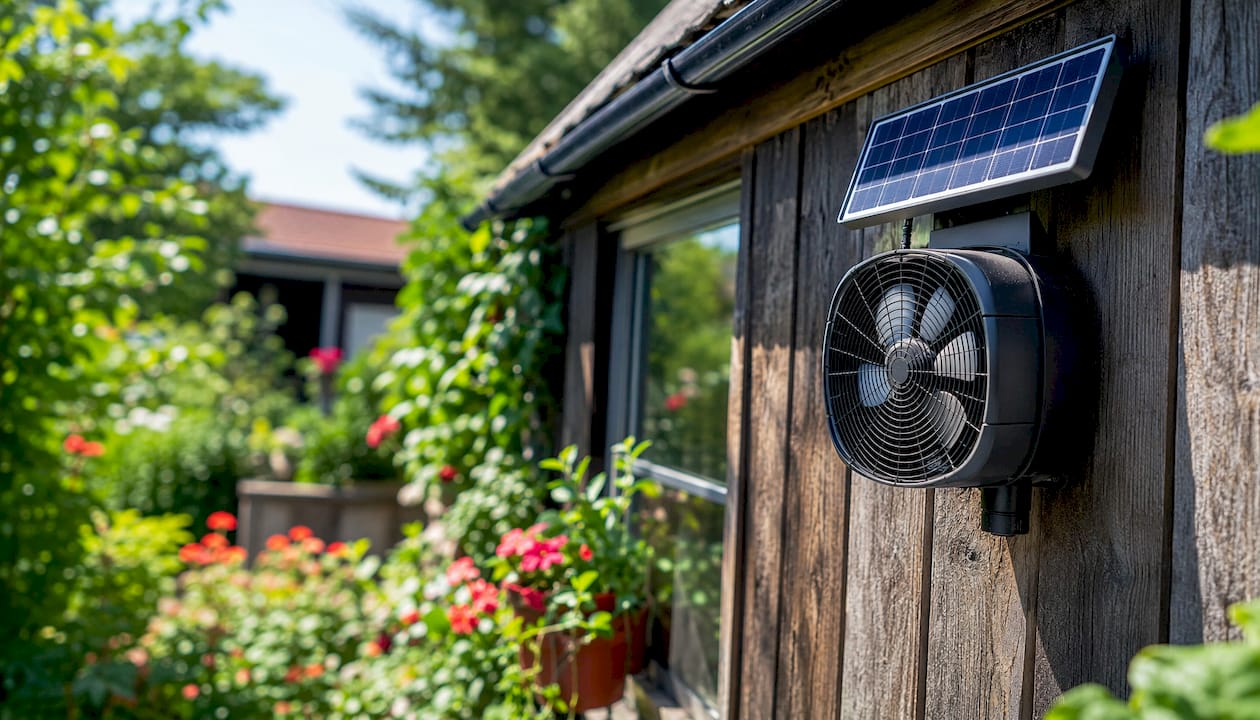
These are the most common entry point. The solar panel connects directly to the fan motor, so the fan runs only when sunlight is present. A 5W solar panel can push up to 90 cubic meters per hour of airflow, which is enough for a small to medium shed. There's no battery to replace, no controller to program, and no wiring beyond the panel-to-fan cable. The trade-off is simple: no sun, no airflow.
Solar fans with battery backup
For sheds that need ventilation after dark or during extended cloudy stretches, battery-backed units store energy during daylight and run the fan continuously. Users seeking around-the-clock ventilation need to select models with battery or external DC power supply options. These cost more upfront and require occasional battery maintenance, but they suit situations where humidity control overnight matters, such as a greenhouse attached to a shed or a workshop storing moisture-sensitive materials.
Integrated solar vent kits
These combine a larger panel, a higher-wattage fan, and mounting hardware in a single package. Solar exhaust fans come in wattages from 25W to 80W and fan sizes from 6 inches to 10 inches, with airflow ratings scaled to match. A 25W, 8-inch shutter exhaust fan delivers 496 CFM, which handles a mid-size workshop or barn bay comfortably.
Passive solar vents
These have no moving parts. They rely on convection and wind to push air through a solar-heated vent channel. Airflow is lower and less predictable than an active fan, but they require zero maintenance and last indefinitely. They work best as a supplement to an active system, not as the primary solution for a hot shed.
Key features to look for across all types:
- Adjustable airflow direction (ball joint or louver)
- Low-noise motor (27–39 dB is the typical range for quality units)
- Overcast sensitivity for fans that run in partial light
- Waterproof panel rating for outdoor exposure
- Mounting flexibility: roof vent, wall mount, or ground spike
How to install and maintain solar ventilation in your shed
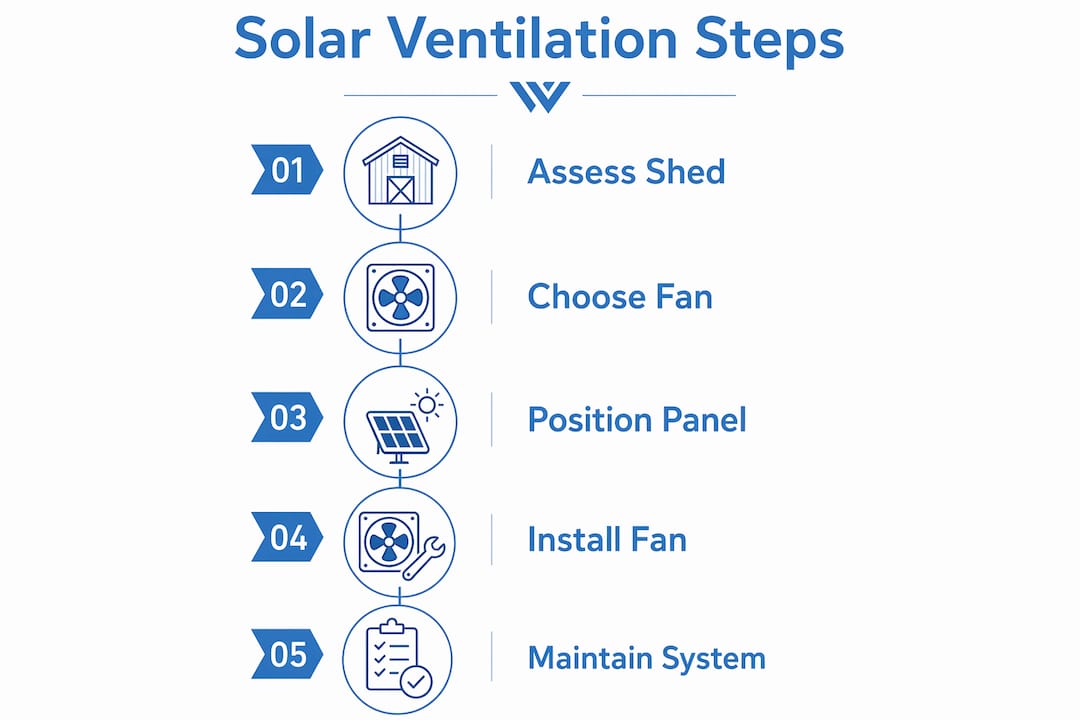
Installation is genuinely straightforward for direct-drive units. No licensed electrician, no conduit, no breaker box. Here's how the process works from start to finish:
- Choose your fan location. Mount the fan high on a wall or near the roof ridge. Hot air rises, so exhausting it from the highest point in the shed moves the most heat per unit of airflow.
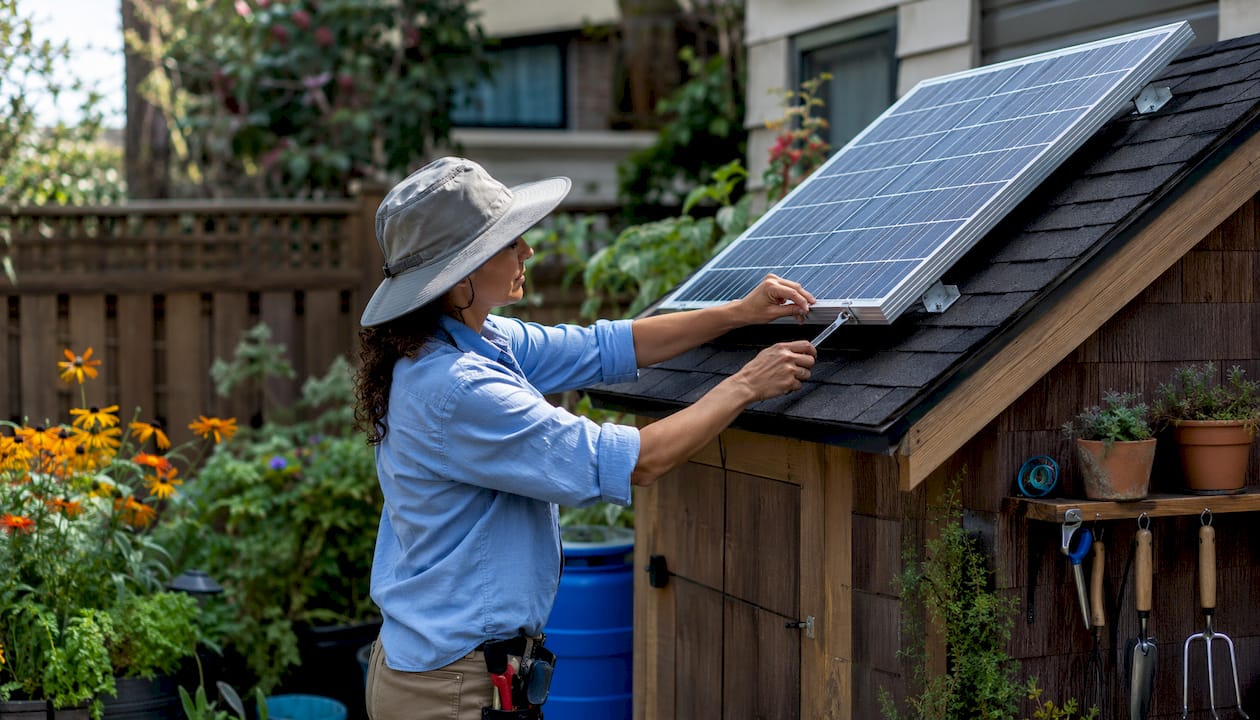
- Select your panel location. The panel needs unobstructed sun for as many hours as possible. South-facing placement at a tilt angle matching your latitude gives the best daily output. Avoid spots where trees, roof overhangs, or neighboring structures cast shade during midday.
- Mount the fan. Wall mounting uses standard screws into framing. Roof mounting requires cutting a vent hole and sealing around the flange with roofing caulk or flashing. Ground spike mounting works for small units placed inside or just outside the shed.
- Run the cable. No mains wiring is needed. Connect the panel's output cable to the fan's input connector. Most kits include a 5-meter cable, which covers the distance between a wall-mounted fan and a ground-spiked panel in most shed setups.
- Test before finalizing. Point the panel at the sun and confirm the fan spins. Adjust the airflow direction using the ball joint or louver to direct exhaust where you want it.
- Seal penetrations. Any hole through the shed wall or roof needs weatherproofing. Use exterior-grade caulk around wall penetrations and proper flashing for roof installations.
Maintenance is minimal but not zero:
- Wipe the panel surface clean every few months. Dust, pollen, and bird droppings reduce output noticeably. Keeping the panel surface clean is the single most effective maintenance step.
- Check fan blade rotation at the start of each season. Debris can jam the blades or slow the motor.
- Inspect cable connections annually for corrosion, especially in humid climates.
- Recheck panel angle in spring if you adjusted it for winter sun.
Pro Tip: Position the solar panel so it faces south and tilts at roughly the same angle as your latitude in degrees. A panel in Denver tilted at 40° will outperform a flat-mounted panel by a meaningful margin over a full season, especially in spring and fall when the sun sits lower in the sky.
Building code and safety notes: Most solar shed fans operate on low-voltage DC (typically 12V or 18V) and fall outside the scope of electrical permits in most US jurisdictions. That said, check with your local building department if you're cutting a hole in a roof or wall, since structural penetrations sometimes require a permit regardless of the electrical classification. Never connect a solar fan directly to household AC mains power.
Troubleshooting common issues:
- Fan not spinning in full sun: Check the panel-to-fan cable connection. A loose connector is the most common cause.
- Fan spinning slowly: Shade on any part of the panel drops output significantly. Identify and remove the obstruction.
- Fan running at night (battery units): Verify the controller's light-sensor threshold is set correctly.
- Excessive noise: A rattling fan usually has a blade touching the housing. Loosen the mounting screws, realign, and retighten.
What does solar shed ventilation cost, and what should you expect?
Solar ventilation for sheds covers a wide price range, and the differences between price points are real.
| System type | Typical price range | Airflow capacity | Battery backup | Best for |
|---|---|---|---|---|
| Small direct-drive kit (5W) | — | Up to 90 m³/h | No | Small sheds, greenhouses |
| Mid-range wall-mount (25W) | $80–$100 | ~496 CFM | No | Medium sheds, workshops |
| Advanced kit (50W–80W) | $200–$300 | High CFM | Optional | Large barns, workshops |
| Battery-backup system | $250–$350 | Varies | Yes | 24-hour ventilation needs |
Prices for solar shed fans range from around $50 for basic low-wattage units to several hundred dollars for advanced kits with larger panels or battery backup. US-manufactured units typically sit at the higher end of each tier, reflecting better motor quality, more durable housings, and longer warranty coverage.
The operational cost comparison with electric fans is straightforward. Solar ventilation fans eliminate running electricity costs entirely. An electric exhaust fan running eight hours a day through a five-month summer adds up to real money on your utility bill, year after year. A solar unit pays for itself and then keeps running for free.
What drives cost differences:
- Wattage and fan size: Higher wattage means more airflow and a larger, more expensive panel.
- Build quality: Brushless motors last longer than brushed motors. Waterproof-rated panels survive outdoor exposure far better than unrated ones.
- Battery backup: Adds cost and complexity. Worth it for some applications, unnecessary for most daytime-only shed cooling.
- US manufacture: American-made units carry a quality premium, but they also tend to come with better warranty terms and more reliable customer support.
A one-year warranty is standard across most entry-level and mid-range units. Higher-end systems from established manufacturers often extend that to two or three years. When evaluating cost, factor in replacement cost if a cheap motor fails after one season versus a quality unit that runs for a decade.
Why solar ventilation works best exactly when your shed needs it most
The most underappreciated feature of a direct-drive solar fan is that it doesn't need a thermostat. It already has one built into physics.
That's not a marketing claim. It's how direct-drive systems work: the panel converts sunlight to DC power in real time, and the fan speed tracks solar intensity directly. At 7 AM when the shed is still cool, the fan turns slowly. By noon when interior temperatures peak, the fan is running at full speed. Solar fans reach peak performance during the warmest part of the day when solar gain is greatest, naturally matching ventilation demand without any sensors, timers, or controllers.
This self-regulating behavior is why most shed owners don't need battery backup. The heat problem is a daytime problem. The fan solves it during daylight and rests at night when temperatures drop and humidity stabilizes. Direct-drive solar fans operate only under direct sunlight, converting solar energy straight to fan power without intermediate battery storage, so their performance curves tightly follow daylight intensity.
For sheds storing tools, lumber, paint, or equipment, this timing is ideal. The contents are protected during the hours when heat and humidity do the most damage. Westernharmonics has built its entire product line around this engineering reality: design for the conditions that actually exist in the field, not for theoretical worst-case scenarios that require expensive workarounds.
For those considering solar power more broadly across accessory structures, the role of solar in off-grid buildings extends well beyond ventilation, covering lighting, charging, and full energy independence.
Westernharmonics solar ventilation kits: built for real-world conditions
If you've read this far, you know what a well-designed solar ventilation system looks like. Westernharmonics builds exactly that, and has been doing it longer than anyone else in the US market.

We created the solar-powered fan kit category in the United States. That's not a claim we make lightly. Before Westernharmonics, there was no domestic market for purpose-built solar ventilation kits designed for barns, sheds, greenhouses, and off-grid rural structures. We built it from the ground up, and we've spent years refining the hardware based on real-world feedback from property owners across the country.
Our systems are engineered for durability in harsh conditions: dust, heat, UV exposure, and years of outdoor use. Every unit is designed with the same principle that makes solar ventilation work so well for sheds: keep it simple, keep it reliable, and let the sun do the work. No unnecessary complexity, no components that fail when you need them most.
Whether you're cooling a 100-square-foot garden shed or ventilating a 2,000-square-foot workshop, Westernharmonics has a kit sized for the job. Visit westernharmonics.com to see our current lineup, compare airflow specs, and find the right system for your structure.
Key Takeaways
Solar shed ventilation is the most cost-effective way to control heat and humidity in an outdoor shed, requiring no electrical wiring and delivering peak airflow exactly when temperatures are highest.
| Point | Details |
|---|---|
| Direct-drive is the default | Most shed owners need a direct-drive solar fan with no battery; it runs free during the hours heat builds most. |
| Size to your shed | A 5W panel moves up to 90 m³/h for small sheds; a 25W system delivers ~496 CFM for mid-size workshops. |
| Installation is DIY-friendly | No mains wiring is needed; mount the fan high, face the panel south, connect the cable, and you're done. |
| Solar beats electric on cost | Solar fans eliminate running electricity costs entirely, paying for themselves over a single season of use. |
| Westernharmonics leads the category | As the original US pioneer of solar fan kits, Westernharmonics offers field-proven systems for sheds, barns, and workshops. |