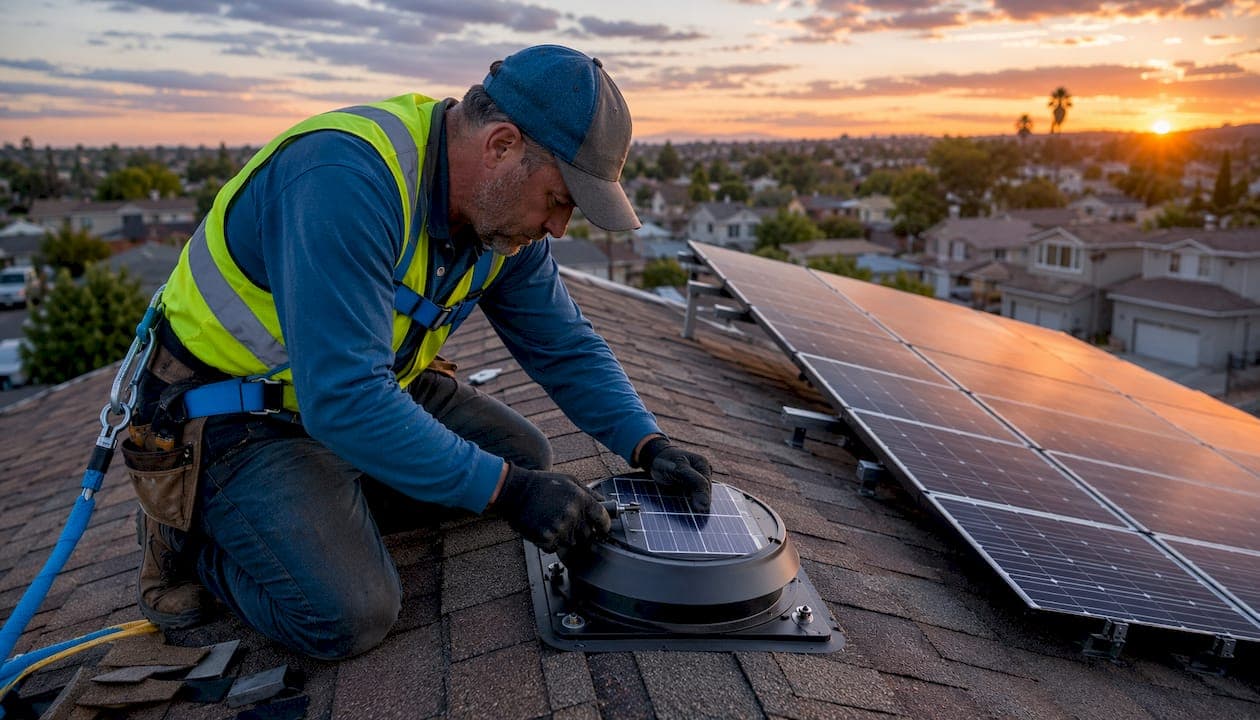
Solar attic fans are the stronger choice for sunny, hot, or off-grid homes where daytime heat is the primary problem and grid power is inconvenient or unavailable. Electric fans win when you need reliable evening or nighttime operation, have a shaded roof, or are managing moisture in a humid climate. For a well-sealed, properly insulated attic with adequate passive ventilation, neither type is necessary.
Three quick scenarios: a sun-drenched suburban house in Phoenix or Dallas benefits most from a solar fan, which runs hardest exactly when the attic is hottest. A shaded northern roof or a coastal attic with persistent evening humidity calls for an electric fan with a humidistat. An attic that already has ridge and soffit venting and a tight ceiling plane likely needs neither.
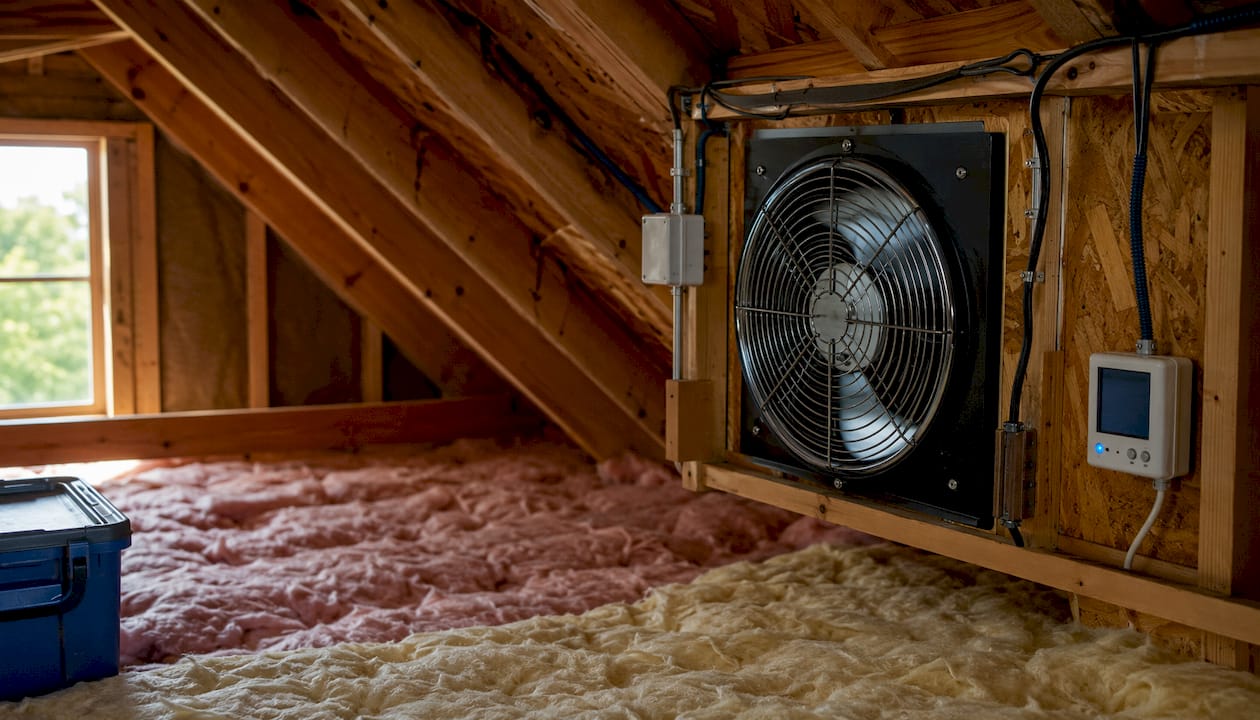
Pro Tip: Before buying any powered fan, air-seal your attic floor. Building science professionals consistently warn that attic fans pull air along the path of least resistance — and if your ceiling has gaps around light fixtures or plumbing stacks, that path runs straight through your conditioned living space, raising your cooling bill instead of lowering it.
Table of Contents
- How does a solar attic fan compare to an electric one?
- How solar and electric attic fans actually work
- Trade-offs worth knowing before you decide
- Which option fits your climate and situation?
- What does each option actually cost, and when does it pay back?
- Installation checklist and what to verify before you start
- Mistakes that make attic fans work against you
- What should you do next?
- Key Takeaways
- Why we focus on solar ventilation
- Westernharmonics solar ventilation kits: built for where the grid ends
- Useful sources and further reading
How does a solar attic fan compare to an electric one?
| Dimension | Solar Fan | Electric Fan |
|---|---|---|
| Upfront/installed cost | $300–$600 per unit; no electrician needed | $150–$400 per unit; add $100–$300 for wiring |
| Operating cost | Zero grid electricity | Ongoing kWh cost at local utility rate |
| Best climate/exposure | Sunny, hot, south-facing roof | Shaded, humid, or northern exposure |
| Typical airflow | 800–1,900 CFM; output tied to sun angle | 1,000–1,600+ CFM; consistent regardless of sun |
| Installation complexity | Roofer only; no wiring | Roofer plus licensed electrician |
| Maintenance and lifespan | Minimal; brushless DC motors; 15 years | Periodic motor service; 10–20 years |
| Noise | Very quiet; brushless DC | Moderate; AC motor hum |
| HVAC/moisture impact | Daytime only; lower depressurization risk | 24/7 capable; humidistat control available |
| Off-grid reliability | Fully grid-independent | Requires utility power |
Key takeaways from the table: the CFM-per-watt figure matters because it determines how much ventilation you get per dollar of operating cost. Solar fans deliver that ventilation at zero grid cost, but only while the sun is up. Electric fans give you control over timing, which is critical for moisture management after sundown.
- Solar fans are best when peak attic heat and peak solar output coincide — which they do in most hot, sunny U.S. climates.
- Electric fans are best when the problem persists into the evening or when the roof sees too much shade to generate reliable PV output.
- Neither type compensates for undersized soffit intake or a leaky ceiling plane.
How solar and electric attic fans actually work
Solar fans run on a PV panel wired directly to a brushless DC motor. No grid connection, no timer to set. The panel produces power when sunlight hits it, the motor spins, and the fan exhausts hot attic air. That automatic, sun-synchronized operation is the core advantage: solar fans match runtime to peak attic heat without any manual intervention.
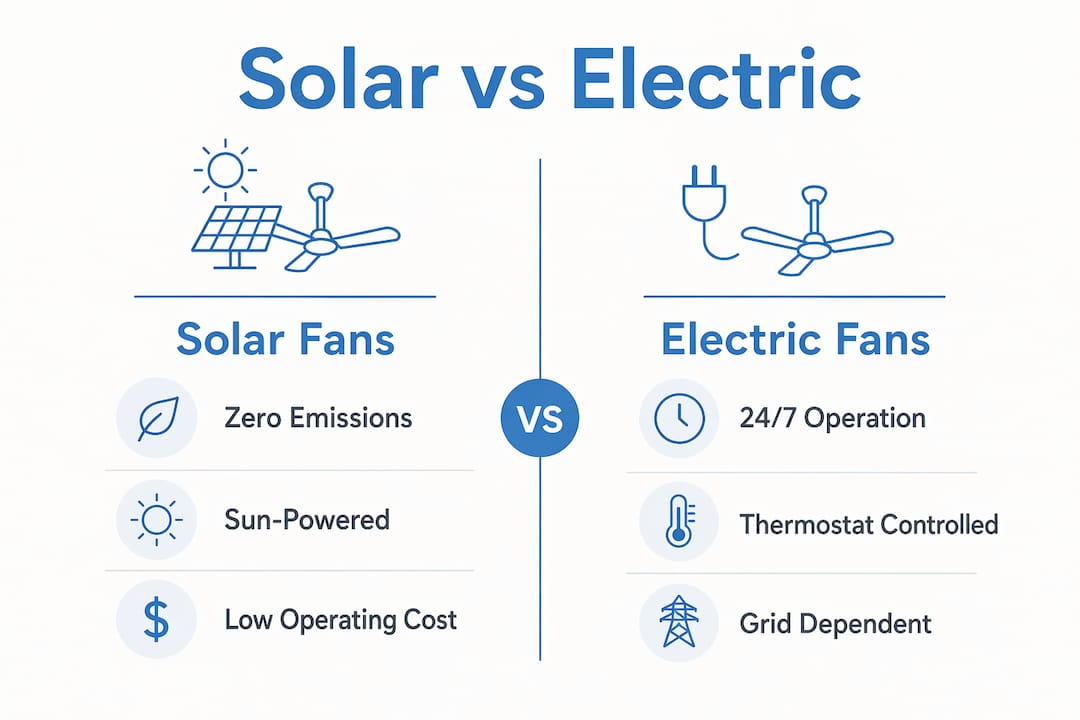
Electric fans use an AC motor connected to your home's wiring, controlled by a thermostat, humidistat, or timer. That wiring is what gives them flexibility — you can run them at 2 AM if the attic is still hot and humid. The trade-off is installation complexity and a monthly electricity draw.
Both types work the same way aerodynamically: the fan exhausts air through the roof, and replacement air enters through soffit vents. That intake pathway is where most installs go wrong. If soffit area is undersized or blocked by insulation, the fan creates negative pressure and draws conditioned air from the living space through ceiling gaps. A rough rule of thumb: roughly 1 square inch of net free intake area per CFM of fan capacity.
Pro Tip: Seal ceiling penetrations — light fixture boxes, plumbing stacks, wiring holes — before any powered fan goes in. That single step determines whether the fan helps or hurts your energy bill.
Trade-offs worth knowing before you decide
Performance and CFM per watt
Solar fans typically deliver 800–1,900 CFM from a 15–48 watt panel. Electric fans in the same price range often move 1,000–1,600 CFM but draw 100–300 watts continuously. The CFM-per-watt ratio is the honest efficiency metric: a solar fan running on free sunlight at 40 CFM/watt beats an electric fan at 10 CFM/watt on operating cost every time, provided the sun is shining.
Real-world field data from a Florida Solar Energy Center case study found that photovoltaic attic ventilators lowered peak attic temperatures by over 20°F and reduced measured space-cooling demand by about 6% — roughly 460 kWh annually in that study home. Meaningful, but modest. Expect similar results only when the attic is poorly insulated, the roof has low solar reflectivity, and HVAC equipment sits in the attic space.
Environmental footprint
Solar fans produce zero operational carbon emissions. Electric fans draw from the grid, which still carries a carbon cost in most U.S. utility regions. Over a 15-year lifespan, that difference adds up, though the manufacturing footprint of the PV panel partially offsets the operational advantage.
Climate fit
Solar fans are a targeted upgrade, not a universal fix. They perform best in hot, dry, or hot-humid climates with consistent sun. In temperate or shaded conditions, output drops and so does the payback case.
When passive ventilation is enough
Passive ventilation — a continuous ridge vent paired with adequate soffit intake — often outperforms a poorly installed powered fan. If your attic already has that system and a tight ceiling plane, adding a powered fan may do more harm than good by disrupting balanced airflow.
Which option fits your climate and situation?
Direct rules of thumb:
- Hot, sunny climates (Phoenix, Dallas, Atlanta): Solar fan is the clear pick. Peak output aligns with peak heat. No electricity cost, no electrician.
- Humid coastal or evening-heat climates (Houston, Miami, New Orleans): Electric fan with a humidistat. Moisture control after sundown requires runtime the sun can't provide.
- Shaded or northern roofs (Pacific Northwest, New England): Electric fan, or evaluate whether passive ventilation is sufficient first.
- Off-grid cabins, barns, rural outbuildings: Solar fan is the only practical choice where grid power is unavailable or expensive to run.
- Well-insulated, well-ventilated attic: Neither. Invest in air sealing and insulation before spending on a powered fan.
If your roof has good southern exposure, checking whether it's solar-ready before installation saves time and avoids shading problems that cut panel output.
What does each option actually cost, and when does it pay back?
Solar fans typically run $300–$600 per unit installed, with no electrician required. Most attics need one to three units depending on square footage. Electric fans cost $150–$400 per unit, but wiring adds $100–$300 per fan in electrician time, and permits may be required.
Operating cost math for electric fans follows a straightforward template:
- Fan kWh per month: (Fan watts × daily hours) ÷ 1,000 × 30
- AC kWh avoided per month: Estimate based on reduced runtime (consult your utility's average cooling kWh or use a home energy monitor)
- Net monthly savings: (AC kWh avoided − Fan kWh) × your local $/kWh rate
- Payback period: Total installed cost ÷ net monthly savings
Solar fans skip step 1 entirely since operating costs are zero. Their payback depends entirely on how much A/C runtime they displace. Attics with HVAC ducts running through them show the strongest savings; well-insulated attics with no ducts show the weakest.
Installation checklist and what to verify before you start
Contractor checklist
- Measure total soffit net free area and confirm it meets or exceeds the fan's CFM requirement
- Size the fan to attic volume, not just square footage
- Flash and curb the roof penetration per manufacturer specs; use proper roofing sealant for the roof type (asphalt, metal, tile)
- For electric fans: pull the required electrical permit and coordinate a licensed electrician
- Install a thermostat (set to 100–110°F) and a humidistat (set to 50–60% RH) on electric units
- Confirm no combustion appliances (furnaces, water heaters) are located in or adjacent to the attic space
Homeowner pre-install checklist
- Inspect soffit vents for blockage by insulation; install baffles if needed
- Air-seal light fixture boxes, plumbing stacks, and wiring penetrations at the ceiling plane
- Check for existing ridge vent — running a powered fan alongside a continuous ridge vent without evaluation can short-circuit airflow
- Confirm roof orientation for solar fans: south or southwest placement maximizes panel output
Safety note: A powered fan that depressurizes the attic can backdraft combustion appliances, pulling flue gases into the living space. If a gas furnace, water heater, or wood stove shares air with the attic, have a combustion safety test done before and after installation.
Mistakes that make attic fans work against you
- Undersized or blocked soffits: The fan pulls from ceiling gaps instead of outside air, conditioning the attic at your expense.
- Large ceiling leaks left unsealed: Even a well-sized fan becomes a conditioned-air pump if the ceiling plane is not airtight.
- Solar panel in partial shade: A single shaded cell can cut panel output by 30–50%, gutting the solar fan's performance advantage.
- No thermostat on electric fans: An always-on electric fan can use more electricity than it saves in A/C reduction, especially in mild weather.
- Improper humidistat placement: Mount it in the attic airstream, not near the exhaust point, or readings will be skewed.
- Installing over a continuous ridge vent without assessment: The ridge vent may short-circuit the fan's intake, pulling air from the ridge rather than the soffits.
Run a simple smoke test or blower door test to locate ceiling leaks before committing to any powered fan. It takes an hour and changes the entire cost-benefit calculation.
What should you do next?
Follow this decision flow:
- Inspect intake: Measure soffit net free area. If it's inadequate, fix it first.
- Air-seal the ceiling plane: Light fixtures, plumbing stacks, wiring penetrations. This step alone often reduces attic heat gain noticeably.
- Evaluate passive ventilation: If ridge and soffit venting are balanced and the ceiling is tight, you may not need a powered fan at all.
- If the attic still overheats: Choose solar for sunny, south-facing, or off-grid sites. Choose electric for shaded roofs, humid climates, or when evening operation is required.
- Size correctly: Match CFM to attic volume and confirm soffit intake can support the fan's rated output.
- For solar installs: Westernharmonics solar ventilation kits are engineered for exactly these conditions — reliable daytime cooling with no grid dependency and no monthly electricity cost.
Key Takeaways
Solar fans eliminate operating costs and work best in sunny, hot climates; electric fans deliver consistent 24/7 control and suit shaded roofs and humid climates where evening moisture management matters.
| Point | Details |
|---|---|
| Air-seal first | Seal ceiling penetrations before any powered fan; gaps let fans pull conditioned air from living spaces. |
| Solar wins in sun | Solar fans match peak output to peak attic heat, delivering ventilation at zero grid electricity cost. |
| Electric wins at night | Electric fans with humidistats control evening moisture and run regardless of sun or cloud cover. |
| Passive may be enough | A balanced ridge-and-soffit passive system often outperforms a poorly installed powered fan. |
| Westernharmonics for solar | Westernharmonics solar ventilation kits are built for off-grid and sunny-site installs with no grid dependency. |
Why we focus on solar ventilation
Most articles on this topic treat the solar vs. electric question as a close call. We don't. For the off-grid barns, rural workshops, and remote homesteads we build products for, an electric fan isn't a trade-off — it's simply not an option. Grid power either doesn't reach the site or costs more to run than the fan is worth.
What we've learned from years of building solar ventilation hardware is that the technology works best when it's kept simple: a quality DC motor, a well-positioned panel, and adequate intake. Complexity is where installs fail. A solar fan with no moving parts beyond the motor and no wiring beyond the panel-to-motor connection is a system that keeps running in a dusty barn or a remote greenhouse without service calls.
The building-science caution about air sealing is real and we take it seriously. A solar fan installed over a leaky ceiling in a poorly ventilated attic will underperform. That's why our guidance always starts with intake and sealing, not the fan itself. The fan is the last step, not the first.
Westernharmonics solar ventilation kits: built for where the grid ends

If your situation calls for solar — a sunny roof, an off-grid outbuilding, or a rural property where running electrical conduit isn't practical — Westernharmonics solar ventilation kits are designed for exactly that job. We pioneered the solar fan kit category in the United States, and our systems are built around brushless DC motors, durable hardware, and straightforward installation that doesn't require an electrician.
Our kits are used in barns, greenhouses, workshops, and rural homes across the country where reliable daytime cooling matters and monthly electricity costs don't fit the budget. Every kit ships ready to install, sized for real attic and outbuilding conditions, and backed by direct support from the team that designed it.
Ready to size the right kit for your site? Visit Westernharmonics to explore solar ventilation systems and get started.
Useful sources and further reading
The following sources back the claims in this article and are worth consulting for measurement methods and region-specific data:
- Building America Solution Center — Attic Ventilation Fans: DOE-backed overview of powered vs. passive ventilation, energy impacts, and code considerations including ENERGY STAR guidance.
- Pro Remodeler — Do Solar-Powered Attic Fans Work?: Building-science perspective on air sealing, depressurization risks, and when solar fans help vs. hurt.
- Trill Roofing — Solar vs. Passive Attic Ventilation: Practical comparison of passive and powered systems, intake sizing rules, and backdrafting risks.
- Whole House Fan — Energy Efficient Attic Fan: Solar vs. Electric: CFM-per-watt analysis, payback calculation framework, and control strategy guidance.
- Langy Energy — Do Solar Attic Fans Really Work?: Summary of Florida Solar Energy Center field data on temperature reduction and cooling-energy savings.
- San Diego Solar — Solar Roofing: Context on how attic heat affects roofing material longevity, useful for homeowners bundling ventilation and roofing work.