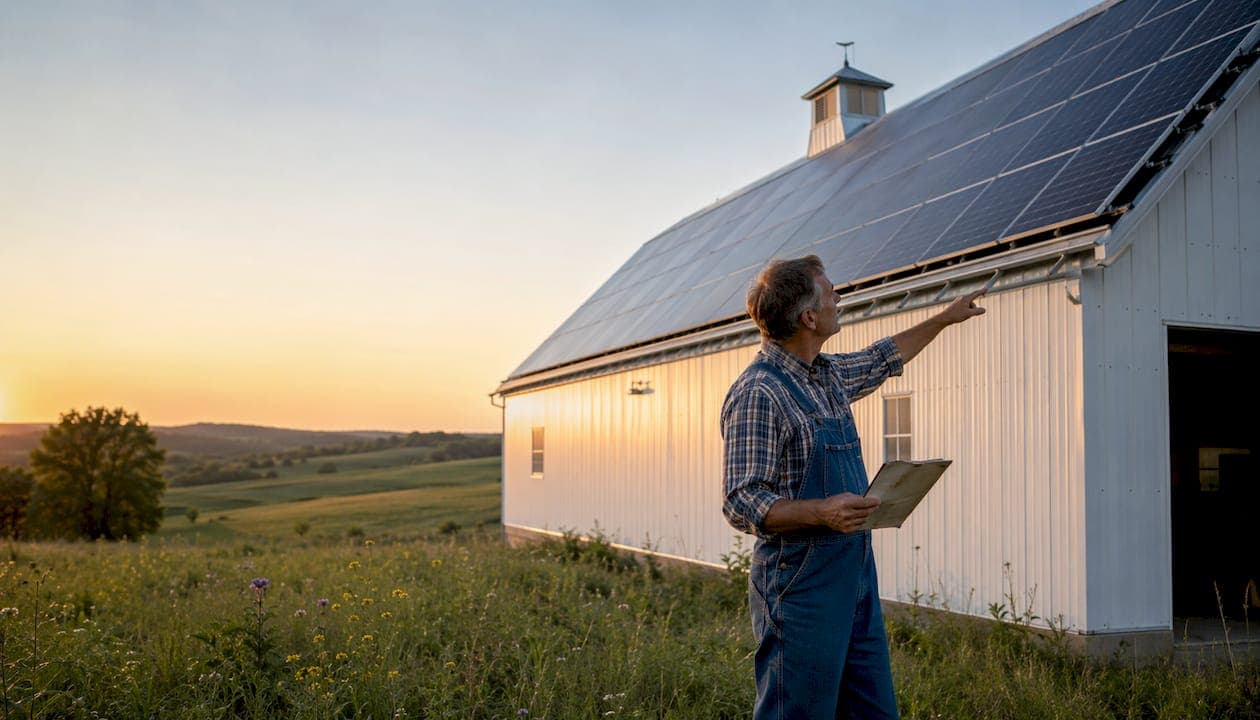
Solar barn ventilation works. When sized correctly, a direct-coupled or battery-backed solar ventilation system delivers reliable daytime climate control, reduces electricity costs, and keeps animals healthier without running a grid-tied power line to every outbuilding on your property. The technology is mature, the components are straightforward, and the payback math is favorable for most U.S. farm operations.
Three fast decisions:
- Daytime-only cooling (small hobby barns, storage, workshops): direct PV-to-fan, no battery needed, lowest cost and simplest install.
- Continuous or overnight ventilation (livestock, dairy, poultry, swine): PV plus a LiFePO4 battery bank for after-dark runtime.
- Large commercial operations (tunnel-vent swine, large dairy): hybrid or grid-tied system with solar offsetting the bulk of the load.
Kit path quick guide: A small hobby barn fits a single-panel direct-PV kit. A mid-size livestock barn needs a PV-plus-battery setup sized to run fans through the night. A large commercial operation benefits from a hybrid configuration where solar handles daytime peak load and the grid or a generator covers gaps.
Table of Contents
- Why does poor barn ventilation cost you money and animal health?
- How does solar barn ventilation work?
- Which barn types benefit most from solar ventilation?
- How do you size a solar ventilation system for your barn?
- What do you need to know before installing solar ventilation on a barn?
- What does solar barn ventilation cost, and what incentives are available?
- What hardware specs actually matter in a barn environment?
- Seasonal maintenance, airflow design, and the mistakes that kill performance
- Westernharmonics solar ventilation kits: the right tool for the job
- Key Takeaways
- Why the conventional wisdom on barn ventilation gets the priorities backward
- Useful U.S. resources and further reading
Why does poor barn ventilation cost you money and animal health?
Heat stress, ammonia buildup, and excess humidity are not just comfort issues. They directly cut into production. Dairy cows under heat stress produce less milk. Poultry mortality rises when temperatures climb without adequate air exchange. Swine gain weight more slowly in hot, poorly ventilated houses. These are measurable losses, not theoretical ones.
The core problems poor ventilation creates:
- Heat stress: Livestock begin experiencing physiological stress when barn temperatures exceed roughly 77°F (25°C) for dairy cattle and 85°F (29°C) for swine, with humidity compounding the effect.
- Ammonia and CO2 buildup: Decomposing manure releases ammonia continuously. Without adequate air changes, concentrations rise to levels that damage respiratory tissue and suppress immune function.
- Moisture and disease: High relative humidity accelerates bacterial and fungal growth in bedding, increases respiratory disease incidence, and corrodes equipment faster.
- Energy cost: Mechanical ventilation is consistently one of the largest electricity draws on a farm operation. Running conventional AC fans around the clock through a hot summer adds up fast.
Ventilation is not optional. The question is whether you pay for it with grid electricity or with sunlight.
How does solar barn ventilation work?
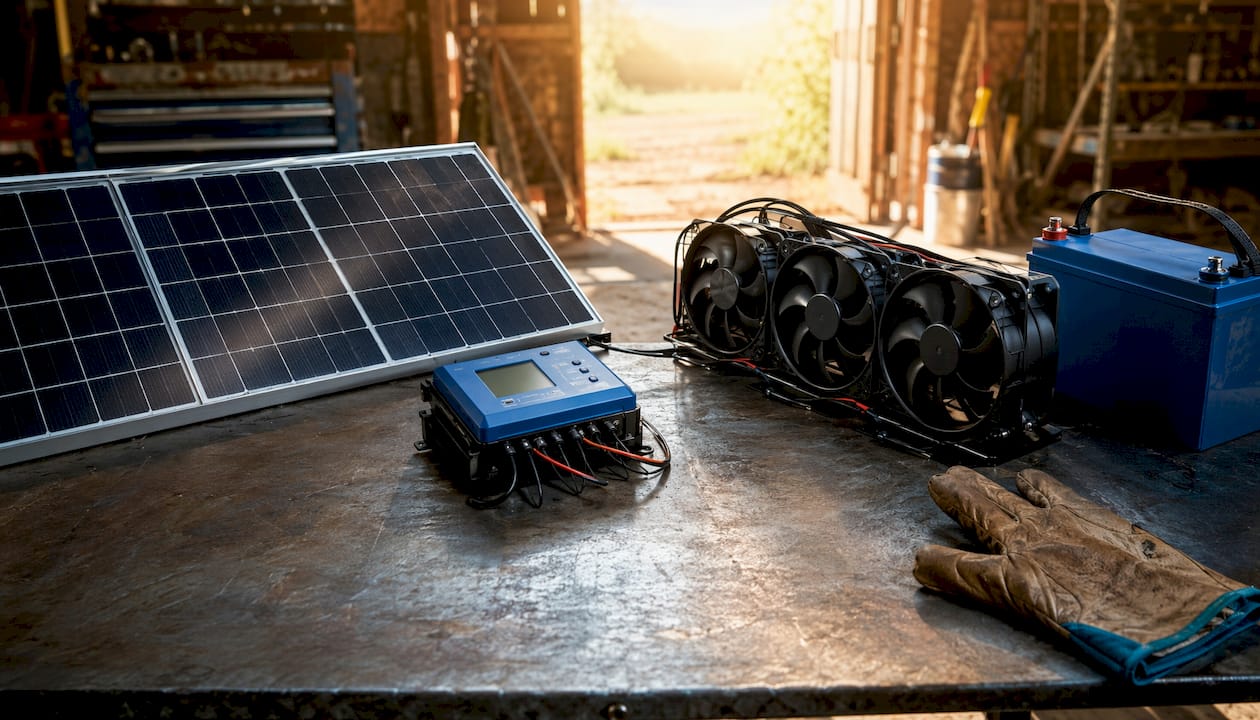
A solar ventilation system converts sunlight into DC electricity, runs that power through a charge controller, and drives one or more DC fans. The core components are the same across all configurations: PV panels, a charge controller, DC fan motors, wiring, and optional sensors for temperature or humidity-triggered automation. A battery bank and inverter are added only when the system needs to run beyond daylight hours or power AC equipment.
The three deployment modes
Direct-coupled PV-to-fan connects panels directly to fans through a controller. Fan speed tracks solar intensity, which is actually useful: the hottest part of the day is also the brightest, so fans run hardest when you need them most. No battery means lower cost and fewer maintenance points.
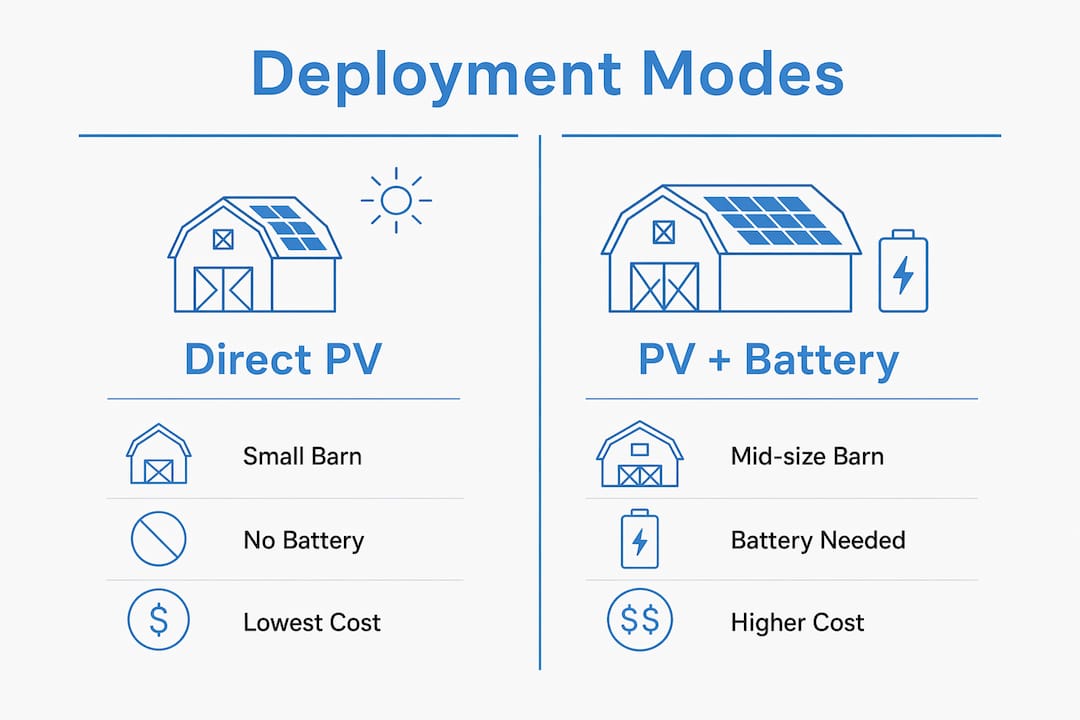
PV plus battery adds a LiFePO4 or lead-acid battery bank. The system charges during the day and draws from storage at night. 12V DC systems with LiFePO4 batteries are the recommended architecture for agricultural environments because they run cooler, require simpler wiring, and offer far better cycle life and thermal stability than lead-acid alternatives.
Hybrid or grid-tied connects solar to the existing electrical service. Solar offsets the peak daytime load, and the grid covers the rest. This suits large operations where fan arrays draw more power than a standalone solar system can economically supply.
A direct-coupled system is not a compromise — it is often the right engineering choice. Fan demand and solar output peak together, which means the system delivers maximum airflow exactly when barn temperatures are highest. Adding a battery is the right move when continuous ventilation is a health or regulatory requirement, not simply a default upgrade.
| Mode | Best for | Battery needed | Relative cost | Key trade-off |
|---|---|---|---|---|
| Direct PV-to-fan | Small barns, daytime-only cooling | No | Lowest | No overnight runtime |
| PV + battery | Livestock, poultry, swine, dairy | Yes | Moderate | Battery adds cost and maintenance |
| Hybrid/grid-tied | Large commercial operations | Optional | Highest | Grid dependency remains |
Solar-powered ventilation systems can reduce barn and greenhouse energy costs by up to 70%, and many farms report electricity bill reductions of 50% or more.
Which barn types benefit most from solar ventilation?
Not every operation has the same ventilation priority. Dairy barns need high air exchange rates to manage heat and humidity. Poultry houses require continuous airflow to control ammonia and temperature around the clock. Swine operations share that continuous need, with the added challenge of high moisture output. Greenhouses have their own set of requirements, including evaporative cooling integration and humidity management for plant health.
| Operation type | Primary priority | Battery need | Control sophistication |
|---|---|---|---|
| Small hobby barn / horse stable | Temperature control | None to low | Basic thermostat or manual |
| Dairy free-stall barn | High air exchange, heat abatement | Moderate | Temperature + humidity sensors |
| Poultry house | Continuous ammonia/temp control | High | Automated multi-stage control |
| Swine confinement | Continuous airflow, moisture removal | High | Automated with backup |
| Greenhouse | Humidity + temperature, evaporative cooling | Low to moderate | Thermostat + humidity controller |
Dairy barns targeting summer performance should aim for a high number of air exchanges per hour, which drives both fan sizing and panel wattage calculations. Poultry and swine operations almost always require battery backup because a ventilation failure at 2 AM in July is a mortality event, not an inconvenience.
Greenhouses are a special case. Evaporative cooling pads work alongside exhaust fans, and the combined load needs to be factored into panel sizing. A direct-PV system can handle daytime cooling effectively, but if you are running irrigation pumps or lighting on the same solar array, battery capacity planning becomes more involved.
How do you size a solar ventilation system for your barn?
Start with CFM, not panels. Every other number follows from the airflow requirement.
Sizing steps
- Calculate required CFM. Multiply barn volume (length × width × ceiling height in feet) by the target air exchanges per hour, then divide by 60. A 100 × 40 × 12-foot dairy barn at 40 exchanges per hour needs 3,200,000 ÷ 60 = roughly 32,000 CFM total fan capacity.
- Convert CFM to motor watts using VER. The Ventilation Efficiency Ratio (VER) measures CFM delivered per watt consumed. A fan rated at 20 CFM/watt needs 1,600 watts to move 32,000 CFM. Higher VER means fewer panels and smaller batteries for the same airflow.
- Account for static pressure. Static pressure above 0.20 inches H2O forces motors to work harder and cuts delivered CFM significantly. Size inlets generously and keep shutters clear to stay below that threshold.
- Size the PV array. Divide total motor watts by average panel output, then add a 20–25% buffer for seasonal variation, panel degradation, and wiring losses. A 1,600-watt fan load needs roughly 2,000–2,100 watts of panel capacity.
- Size the battery bank (if needed). Multiply total fan watts by required overnight runtime in hours. A 1,600-watt system running 8 hours overnight needs 12,800 watt-hours of usable capacity. With LiFePO4 at 80% depth of discharge, that means roughly 16 kWh of installed battery capacity.
Three example configurations
Small hobby barn (direct PV): 30 × 20 × 10-foot barn, two 80-watt DC fans, one 200-watt panel, basic PWM charge controller. Total system cost in the $400–$700 range. No battery.
Mid-size dairy or livestock barn (PV + battery): 80 × 40 × 12-foot barn, six 150-watt DC fans (900W total), 1,200-watt panel array, MPPT charge controller, 15 kWh LiFePO4 battery bank. Handles overnight runtime for continuous ventilation.
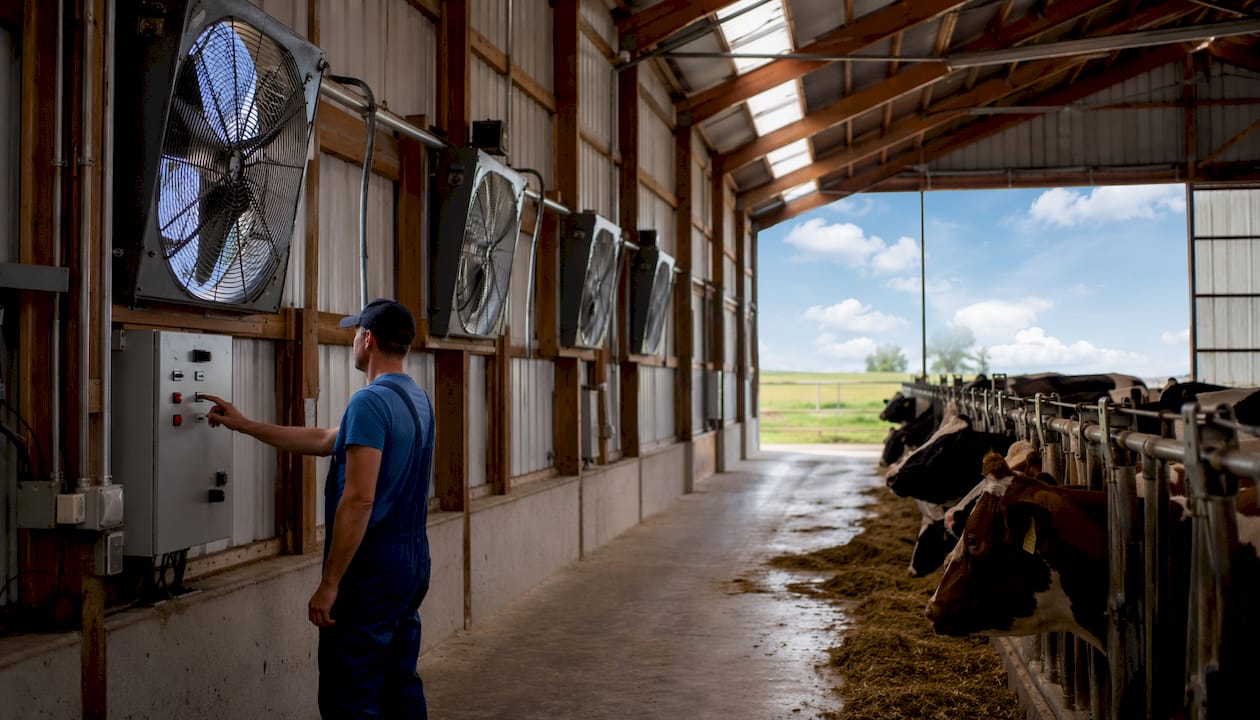
Large tunnel-vent swine barn (hybrid): 200 × 40-foot barn, multiple high-CFM fans totaling 5,000+ watts, 6–8 kW solar array offsetting daytime load, grid or generator backup for overnight and cloudy periods.
Pro Tip: When sizing panels, use your location's peak sun hours, not just the daily average. A barn in Kansas gets roughly 5.5 peak sun hours per day; one in the Pacific Northwest may average 3.5. The NREL PVWatts Calculator gives free location-specific estimates.
What do you need to know before installing solar ventilation on a barn?
Site assessment comes first. Check roof orientation and pitch, shading from trees or adjacent buildings, and structural load capacity before ordering panels. South-facing roof surfaces at a 15–40 degree pitch capture the most annual solar energy across most of the continental U.S.
Installation checklist:
- Confirm roof or ground-mount location, structural load capacity, and panel orientation.
- Route DC cables in UV-rated conduit; keep runs short to minimize voltage drop.
- Mount the charge controller in a shaded, ventilated location away from direct heat.
- Use weatherproof MC4 connectors and IP-rated junction boxes at all outdoor connections.
- Anchor fans and shutters to structural framing, not just sheathing, to handle wind loads.
- Size inlet openings to match fan capacity; a common rule is 1 square foot of free inlet area per 500 CFM.
On the code and permit side: most states require an electrical permit for any new wiring, and grid-tied systems need utility interconnection approval. The USDA REAP program (discussed in the next section) has its own documentation requirements. For agricultural buildings, many jurisdictions follow the International Building Code's agricultural exemptions, but local rules vary. Check with your county extension office or building department before breaking ground.
Retrofitting existing AC fans to DC is possible but rarely cost-effective. A better approach is replacing aging AC fans with new high-VER DC units and running them from the solar array. If you are keeping some AC fans, a hybrid controller can manage both DC solar-powered fans and AC grid fans from a single thermostat, throttling the solar fans first and bringing AC fans online only when solar capacity is insufficient.
Pro Tip: When retrofitting, measure the static pressure in your barn before adding fans. Inlet placement and system-level airflow design matter as much as fan power. Adding more fans to a barn with undersized inlets just creates a vacuum condition that stresses motors and cuts airflow.
What does solar barn ventilation cost, and what incentives are available?
Cost components for a complete solar ventilation system:
| Component | Small system | Mid-size system | Large/commercial |
|---|---|---|---|
| PV panels | $200–$400 | $400–$700 | — |
| DC fans and controls | $200–$400 | — | $2,000–$5,000 |
| Battery bank (if used) | None | $2,000–$5,000 | — |
| Mounting, wiring, labor | $200–$500 | — | $2,000–$5,000 |
| Estimated total | $400–$700 | — | — |
A technical-economic study of a solar PV ventilation system for a livestock farm found a payback period of approximately 3.8 years in a high-solar region, with a positive net present value. U.S. farms in the Sun Belt can expect similar or better results; farms in the upper Midwest or Pacific Northwest should plan for longer payback periods of 5–8 years depending on electricity rates and solar resource.
U.S. incentives that apply directly:
- Federal Investment Tax Credit (ITC): The ITC currently allows eligible businesses to deduct a significant percentage of solar system costs from federal taxes. Confirm the current rate with a tax professional, as the percentage steps down over time under the Inflation Reduction Act schedule.
- USDA REAP (Rural Energy for America Program): Provides grants covering up to 50% of eligible project costs and loan guarantees for agricultural producers and rural small businesses. Applications are competitive; contact your local USDA Rural Development office for current funding cycles.
- State incentives and net metering: Many states offer additional rebates, property tax exemptions on solar equipment, or net metering credits for grid-tied systems. The Database of State Incentives for Renewables and Efficiency (DSIRE) at dsireusa.org catalogs current programs by state.
For small business solar battery backup systems, the combination of ITC and REAP can substantially reduce the net cost of a battery-backed barn ventilation system, often bringing the effective payback period under four years for well-sited operations.
What hardware specs actually matter in a barn environment?
Barns are hard on equipment. Dust, ammonia, moisture, and temperature swings degrade motors, connectors, and electronics faster than most product specs account for. Specify accordingly.
Specs checklist for agricultural ventilation hardware:
- IP rating: Fan motors and controllers should carry at least IP54 (dust-protected, splash-resistant). IP65 or higher is better for wash-down areas or high-humidity swine and poultry houses.
- Corrosion resistance: Aluminum or stainless steel fan guards and housings outlast painted steel in ammonia-rich environments. Check that motor windings are sealed or coated.
- Fan guard design: Guards should be removable for cleaning without tools. Clogged guards are one of the fastest ways to lose CFM without realizing it.
- Warranty: Look for a minimum 3-year warranty on motors and 10-year on panels. Quality DC motors in agricultural service typically last 10–15 years with proper maintenance.
- UV-rated mounting and connectors: PV mounting hardware and MC4 connectors must be rated for outdoor UV exposure. Cheap connectors fail within a few seasons in direct sun.
- Charge controller rating: Size the controller for at least 125% of your panel array's short-circuit current. MPPT controllers recover more energy than PWM in partial-shade conditions.
For off-grid barn installations, LiFePO4 battery chemistry is worth the higher upfront cost. It handles the temperature swings common in unheated barns far better than lead-acid, and the longer cycle life means fewer replacements over a 10-year horizon.
Seasonal maintenance, airflow design, and the mistakes that kill performance
Fan efficiency is not static. Dust accumulates on blades, belts wear, shutters stick, and inlet openings get blocked by debris. Iowa State Extension recommends seasonal cleaning and inspection using a structured ventilation checklist to prevent airflow loss and heat-stress failures during peak summer months.
Seasonal checklist
- Spring (before heat season): Clean all fan blades and guards. Inspect and lubricate shutters. Check belt tension and condition on belt-driven fans. Verify inlet openings are clear and correctly sized. Test thermostat and controller calibration.
- Summer (monthly monitoring): Check blade cleanliness every 30 days. Verify fans are running at rated speed. Monitor barn temperature at animal level, not just near the thermostat. Watch for unusual motor noise indicating bearing wear.
- Fall: Inspect all wiring and connectors for corrosion or rodent damage. Clean PV panels. Check battery state of health if battery-backed. Adjust inlet openings for cooler weather if using natural ventilation in combination.
- Winter: Reduce mechanical ventilation to minimum required air exchange rates. Inspect for condensation on ceilings and walls. Confirm charge controller is functioning correctly in cold temperatures.
Airflow design principles that most barn managers overlook:
- Design inlet placement, fan capacity, and layout as a unified system rather than adding fans piecemeal. More fans in a barn with undersized inlets just creates dead zones and recirculates ammonia-laden air.
- In free-stall dairy barns, angle circulation fans 15–20 degrees downward toward resting areas to maximize convective cooling without blowing directly on bedding or feed.
- Space fans no more than 10 times the fan diameter apart along the barn length to prevent dead zones between units.
Common mistakes:
- Undersizing fans based on barn volume alone, ignoring the target air exchange rate.
- Ignoring static pressure. Debris buildup in inlets can reduce airflow by up to 40% without triggering any obvious alarm.
- Skipping blade cleaning because "they look okay." Dust on blades changes the aerodynamic profile and cuts delivered CFM measurably.
Pro Tip: To measure real-world CFM loss from dirty blades, use a handheld anemometer at the fan discharge before and after cleaning. A drop of more than 10–15% from the rated spec is a clear sign your maintenance interval is too long.
Westernharmonics solar ventilation kits: the right tool for the job
Westernharmonics built the solar-powered fan kit category in the United States. Before copycat products appeared, we were already shipping kits to barn owners, greenhouse operators, and off-grid homesteaders who needed reliable cooling without a grid connection. That field experience shapes every product we make.

Our solar ventilation kits are built around high-VER DC fans, 12V DC architecture, and LiFePO4-ready battery integration. Every kit is designed for straightforward installation without an electrician on site. Hardware is IP-rated for agricultural environments: dust, moisture, and ammonia are expected conditions, not edge cases.
Buyer paths by barn size:
- Small hobby barn or stable: A single-panel direct-PV kit handles daytime cooling with no battery required. Simple, low-cost, and field-proven.
- Mid-size livestock or dairy barn: A PV-plus-battery kit sized for overnight runtime keeps animals comfortable through the night. LiFePO4 battery integration is standard.
- Large commercial operation: Our wholesale and hybrid-system options let you scale panel arrays and fan counts to match tunnel-vent or large free-stall requirements.
We also offer an automated microgrid design tool that answers sizing questions, builds system configurations, and makes off-grid planning accessible without hiring a consultant. If you want a human to walk through your barn layout and load requirements, our design consult pathway is available through the same platform.
Explore Westernharmonics solar ventilation kits and find the right configuration for your operation, or contact us directly for wholesale pricing and design support.
Key Takeaways
Solar barn ventilation is a reliable, cost-effective solution for farms of any size when the system is correctly sized for CFM requirements, deployment mode, and local solar resource.
| Point | Details |
|---|---|
| Match mode to operation | Direct PV suits daytime-only cooling; add LiFePO4 battery backup for livestock requiring overnight ventilation. |
| Size from CFM first | Calculate required air exchanges per hour, convert to watts using VER, then size panels with a 20–25% buffer. |
| Prioritize VER | CFM per watt is the most meaningful metric for long-term cost savings; higher VER means fewer panels and smaller batteries. |
| Maintain seasonally | Clean blades, clear inlets, and inspect shutters each spring; debris buildup can cut delivered airflow by up to 40%. |
| Westernharmonics kits | Purpose-built 12V DC kits with LiFePO4-ready integration cover small hobby barns through large commercial operations. |
Why the conventional wisdom on barn ventilation gets the priorities backward
Most ventilation guides lead with fan count and wattage. We think that is the wrong starting point. The number that actually drives every other decision is VER, and most barn managers have never heard of it.
Here is the practical consequence: two fans can have identical CFM ratings on the spec sheet and wildly different real-world energy costs. The one with the higher VER delivers the same airflow for fewer watts, which means fewer panels, a smaller battery bank, and a lower total system cost. Over a 10-year system life, that difference compounds. Choosing a fan based on CFM alone, without checking VER, is like buying a truck based on payload capacity without looking at fuel economy.
The second thing guides consistently underweight is inlet sizing. We have seen barn owners install a well-designed solar fan array and then wonder why temperatures are not dropping. The answer is almost always static pressure from undersized or blocked inlets. The fans are working. The barn is fighting them. Fix the inlets before adding more fans.
Solar ventilation is not a niche solution for off-grid hobbyists. It is a practical, financially sound upgrade for any barn operation where electricity costs are real and grid reliability is not guaranteed. The technology is there. The incentives are there. The math works.
Useful U.S. resources and further reading
These are the primary references worth bookmarking for incentive applications, design guidance, and technical standards:
- USDA REAP Program: The official USDA Rural Development page for the Rural Energy for America Program. Covers eligibility, grant percentages, application deadlines, and contact information for local offices.
- IRS guidance on the Investment Tax Credit: The authoritative source for current ITC rates, eligible equipment categories, and filing requirements under the Inflation Reduction Act.
- DSIRE — Database of State Incentives for Renewables and Efficiency: Searchable database of every state-level solar incentive, rebate, net metering policy, and property tax exemption currently in effect.
- Purdue Extension AE-97: Natural Ventilation for Livestock Housing: The foundational reference for natural ventilation principles, inlet sizing tables, and building orientation guidance for U.S. livestock barns.
- Iowa State University Extension — Summer Ventilation and Cooling Tips: Practical seasonal checklist for fan inspection, belt maintenance, and heat-stress prevention from the Iowa Pork Industry Center.
- Ontario Dairy Housing: Ventilation Options for Free Stall Barns: Detailed technical benchmarks for air exchange rates, inlet area ratios, and fan placement in dairy free-stall applications. Figures are directly applicable to U.S. dairy operations.
- NREL PVWatts Calculator: Free tool from the National Renewable Energy Laboratory for estimating location-specific solar output, peak sun hours, and annual energy production for any U.S. address.