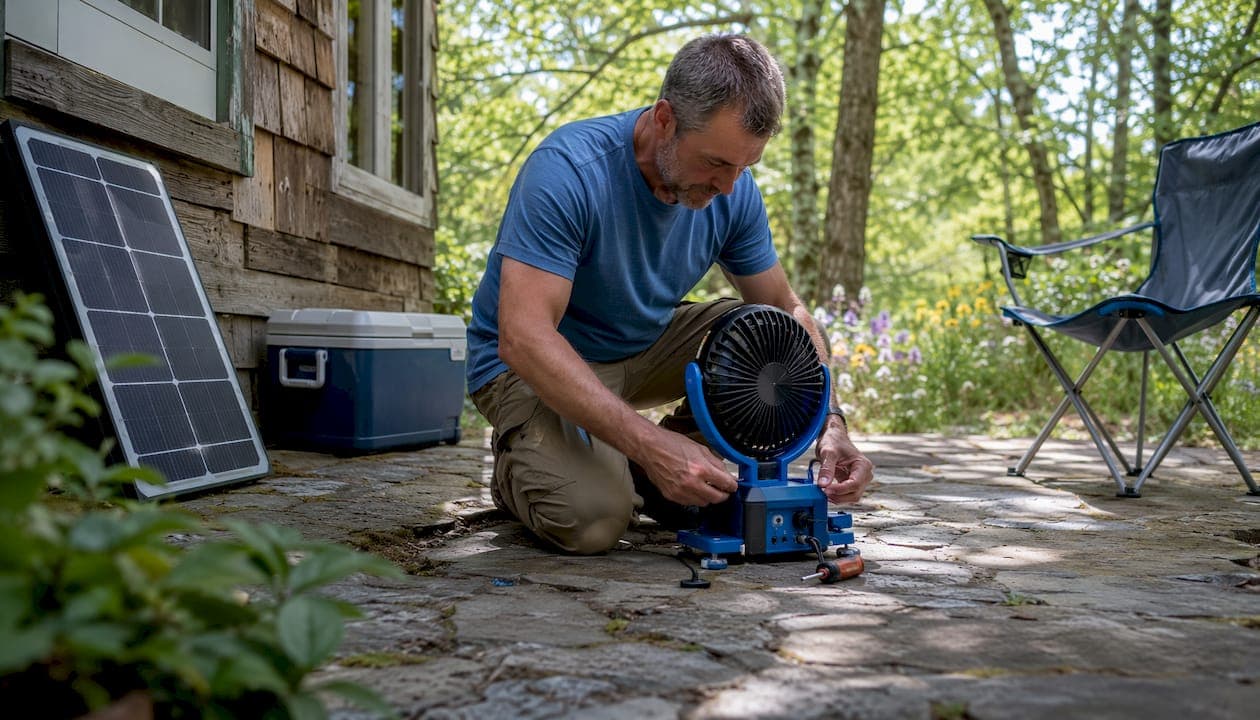
For most off-grid, outdoor, and emergency cooling needs, Westernharmonics' PowerJam-enabled solar fan kit is the strongest choice available in the US market. It pairs a high-efficiency brushless DC motor with a right-sized battery and flexible charging paths, so you get reliable airflow whether the sun is up or not.
TL;DR: The PowerJam kit delivers where generic camping fans fall short: a BLDC motor keeps power draw low, the battery is sized in Wh (not just mAh), and you can charge via solar panel, USB-C, or an external powerbank.
- Best for: barns, greenhouses, tents, emergency outages, and remote workshops
- Expected runtime: roughly 5–24 hours per charge depending on speed setting and battery size
- Primary reason to choose it: purpose-built for off-grid reliability, not repurposed consumer electronics
Table of Contents
- What is a solar fan with battery, and what types exist?
- Which specs actually matter when you're comparing models?
- How do you choose the right solar battery fan for your situation?
- How do you estimate real runtime and recharge time?
- How do you set up and maintain a solar fan and battery system?
- Why Westernharmonics has earned its reputation in off-grid cooling
- Key Takeaways
- What we've learned building solar fans for real off-grid environments
- The Westernharmonics PowerJam solar fan kit
- Useful sources and further reading
What is a solar fan with battery, and what types exist?
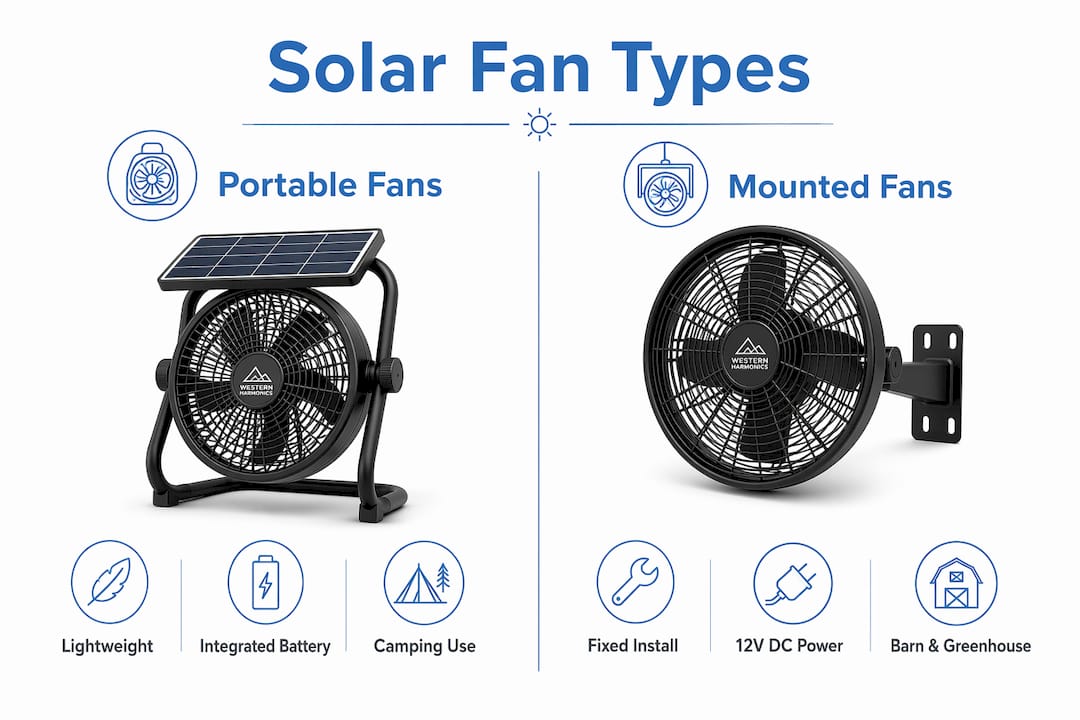
A solar fan with battery is any fan that stores solar energy in an onboard rechargeable cell so it can run without direct sunlight. Three distinct product families cover most buyers' needs.
Portable solar camping fans are lightweight, handle-equipped units with an integrated battery (typically 7,800–10,400 mAh), a small built-in solar panel, and USB ports for charging phones. Retail listings commonly show 10,400 mAh batteries paired with 7 W integrated panels that need 6–8 hours of sun for a full recharge. These are the right call for tent camping and day trips, but their small panels act more as trickle chargers than fast rechargers.
Mounted solar ventilation kits are 12V DC fans designed for fixed installation in barns, coops, or greenhouses. They connect to a dedicated solar array and a separate battery bank, which gives you far more control over runtime and charging speed than any integrated panel can.
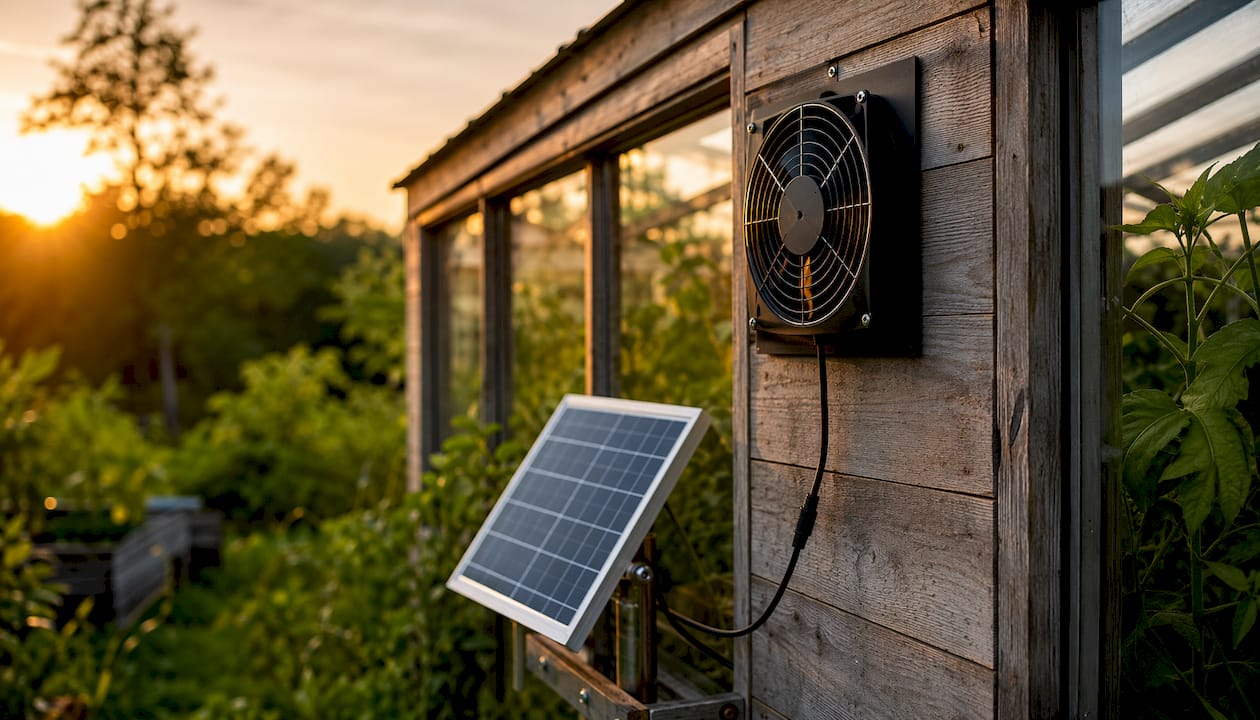
12V DC fans with a separate powerbank sit between the two. You buy the fan and the powerbank independently, size the battery in Wh to match your runtime target, and charge it with whatever panel wattage you have available.
Common features you'll see across all three families: integrated LED lights, USB-A and USB-C output ports, programmable sleep timers (2, 4, 6, or 8 hours), multiple speed modes, and IP-rated enclosures for outdoor use.
Which specs actually matter when you're comparing models?
Spec sheets can be misleading. Here's what to read carefully and what each number means for real-world performance.
Battery capacity: mAh vs. Wh
Milliamp-hours (mAh) alone don't tell you how much energy a battery holds because voltage matters too. Watt-hours (Wh) do. The conversion is simple: Wh = mAh × voltage ÷ 1,000. A 10,000 mAh battery at 3.7V holds 37 Wh. At 7.4V it holds 74 Wh. Always compare Wh when choosing between models.
Motor type: BLDC vs. brushed
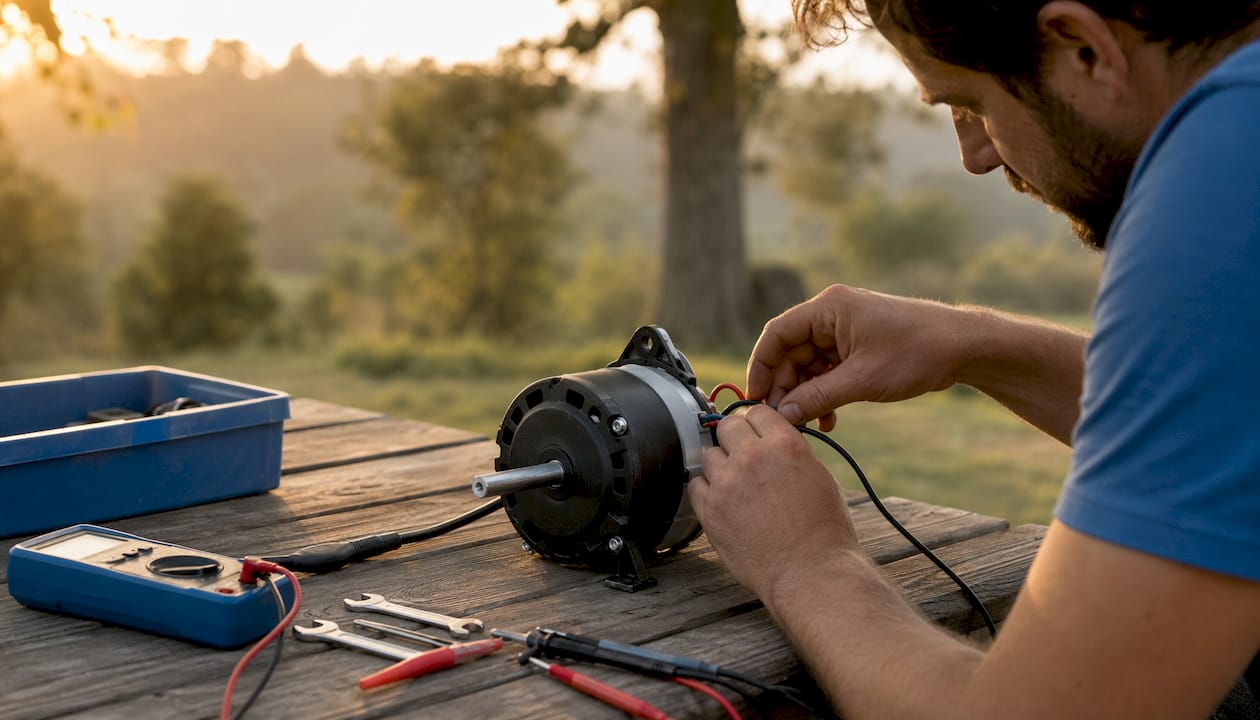
Brushless DC motors deliver higher torque per watt, run quieter, and last significantly longer than brushed motors. For off-grid use, where you can't easily swap a burned-out motor, BLDC is the only sensible choice. Brushed motors wear faster, draw more current, and generate more heat, all of which shorten battery runtime and component life.
Panel wattage and charge speed
A 7 W integrated panel in full sun produces roughly 7 W. Accounting for real-world efficiency losses of 15–30%, expect effective output closer to 5–6 W. Recharging a 37 Wh battery with a 7 W panel takes roughly 6–8 hours of direct sun. A 20 W panel cuts that to under 3 hours for the same battery.
Airflow, speed settings, and noise
Consumer-grade portable fans rarely publish CFM figures. Look for wind speed in meters per second or miles per hour, and count the speed modes. Three to four speeds give you meaningful control over both airflow and battery draw. Noise levels below 45 dB are generally acceptable for sleeping; above 55 dB becomes noticeable in a quiet tent.
Key durability specs to check:
- IP rating: IP44 minimum for outdoor use; IP55 or higher for dusty barns or wet environments
- Operating temperature range: confirm it covers your climate
- Enclosure material: UV-stabilized ABS or powder-coated steel for longevity
Pro Tip: If a product page lists runtime without stating the battery's Wh or the watt draw at each speed setting, treat that runtime claim as unverifiable. A product that hides those numbers is usually hiding a weak battery or an inefficient motor.
How do you choose the right solar battery fan for your situation?
Match the fan to the job before you look at price. Work through this checklist in order.
- Define your use case. Tent camping, emergency backup, chicken coop, greenhouse, or barn each have different runtime, mounting, and durability requirements.
- Set your runtime target. How many hours per night do you need airflow without sun? That number, multiplied by the fan's watt draw, gives you the minimum Wh your battery must hold.
- Assess portability needs. If you're backpacking, weight matters more than battery size. For a fixed barn installation, a larger external battery bank is the better trade-off.
- Check your charging constraints. How many peak sun hours does your location average? That determines whether a small integrated panel is enough or whether you need a dedicated 20 W+ array.
- Set a realistic budget. Entry-level portable fans with integrated batteries start at affordable prices. Purpose-built 12V ventilation kits with external battery compatibility run higher but deliver proportionally more reliability.
Red flags to watch for on product pages:
- Runtime claims with no Wh figure or watt draw listed
- No IP rating for a product marketed for outdoor use
- Non-replaceable, non-standard battery packs
- Integrated panels under 5 W on fans claiming overnight runtime
Use-case guidance:
- Tent/camping: Prioritize weight and portability. A battery in the typical capacity range paired with a 7 W panel covers most overnight stays. Some models list 5–24 hour runtime bands depending on speed, so always check the low-speed draw.
- Emergency/power outage: Go for external powerbank compatibility. A sufficiently large powerbank can run a fan for overnight use at moderate speed, covering a full night without any sun.
- Coop/greenhouse: Use a mounted 12V kit with a dedicated panel and a battery bank sized for 24-hour continuous ventilation. Battery-backed solar ventilation is the only way to guarantee airflow through cloudy days and nights.
How do you estimate real runtime and recharge time?
The math is straightforward once you have two numbers: battery Wh and fan watt draw.
Core formula: Runtime (hours) = Battery Wh ÷ Fan watt draw (W)
Step-by-step worked examples:
- Small portable fan, low speed (7 W draw), 10,000 mAh at 3.7V battery (37 Wh): 37 ÷ 7 = 5.3 hours
- Same fan at high speed (10 W draw): 37 ÷ 10 = 3.7 hours
- Mid-size 12V fan (15 W draw) on a 144 Wh powerbank: 144 ÷ 15 = 9.6 hours
- Larger 16" solar table fan with a high-capacity battery and a 20 W panel: up to 18 hours runtime on a full charge
Recharge time formula: Recharge hours = Battery Wh ÷ (Panel watts × efficiency factor)
Use 0.75 as a conservative efficiency factor for real-world conditions (clouds, angle, temperature losses).
| Battery size | Wh (approx.) | Fan draw | Runtime | 7 W panel recharge | 20 W panel recharge |
|---|---|---|---|---|---|
| 7,800 mAh / 3.7V | 29 Wh | 7 W | 4.1 hours | 5.5 hours | 1.9 hours |
| 10,400 mAh / 3.7V | 38 Wh | 7 W | 5.4 hours | 7.1 hours | 2.7 hours |
| 144 Wh powerbank | 144 Wh | 15 W | 9.6 hours | 27.4 hours | 8.1 hours |
The table makes one thing clear: small integrated panels are fine for daytime top-ups but cannot realistically recharge a large battery overnight. Pairing your fan with an external powerbank sized in Wh is the most reliable path to deterministic overnight runtime.
How do you set up and maintain a solar fan and battery system?
A proper setup takes less than an hour. Skipping it costs you battery life and reliability.
Installation steps:
- Charge the battery fully before first use, using AC or USB rather than the solar panel.
- Mount or position the fan for maximum airflow across the target space. For barns and coops, aim for cross-ventilation: intake low, exhaust high.
- Tilt the solar panel toward true south at an angle equal to your latitude for peak output.
- Connect panel to battery, battery to fan, and verify each charging path before relying on the system.
- Test all speed modes and confirm the battery indicator responds correctly.
Safety notes: Always fuse the wire between an external battery and the fan. Li-ion packs should never discharge below their rated cutoff voltage. Avoid leaving packs in direct sun for extended periods when not in use.
| Maintenance task | Frequency | What to check |
|---|---|---|
| Clean solar panel surface | Monthly | Dust, bird droppings, shading from nearby growth |
| Inspect wire connections | Monthly | Corrosion, loose terminals, chafed insulation |
| Check mounting hardware torque | Quarterly | Vibration loosening on barn/coop installations |
| Test battery charge/discharge | Quarterly | Capacity loss greater than 20% signals aging cell |
| Full battery health check | Annually | Replace if capacity has dropped significantly |
Keeping the panel clean is the single highest-return maintenance task. A dusty panel in a barn environment can lose 15–25% of its rated output, which compounds directly into shorter runtimes.
Why Westernharmonics has earned its reputation in off-grid cooling
Westernharmonics didn't enter an existing solar fan market. We built it. As the original pioneer of the solar-powered fan kit category in the United States, we've spent years engineering DC micro-power systems and off-grid cooling hardware for the environments where failure has real consequences: barns with livestock, greenhouses with crops, remote workshops without grid access.
The PowerJam line reflects that engineering focus directly. It uses a BLDC motor for lower current draw and longer service life, supports external battery and panel compatibility so you're not locked into an undersized integrated panel, and is built to handle dust, heat, and the kind of daily-use punishment that consumer camping fans aren't designed for.
What sets Westernharmonics products apart:
- BLDC motor for maximum efficiency and quiet operation
- Published spec sheets with explicit Wh ratings and runtime estimates
- External powerbank and solar panel compatibility for scalable runtime
- Deployed in barns, greenhouses, and remote workshops across the US
- Warranty and direct customer support from the team that designed the hardware
Pro Tip: When evaluating any solar fan for agricultural use, ask the manufacturer for the motor's rated service hours. A BLDC motor in a quality kit should last tens of thousands of hours. A brushed motor in a consumer camping fan typically won't.
Key Takeaways
A solar fan with battery is only as reliable as its weakest component: size the battery in Wh, choose a BLDC motor, and match panel wattage to your recharge window.
| Point | Details |
|---|---|
| Size battery in Wh, not mAh | Wh = mAh × voltage ÷ 1,000; compare Wh across models for honest runtime estimates. |
| BLDC motor is non-negotiable | Brushless DC motors draw less current, run quieter, and last far longer than brushed alternatives. |
| Small integrated panels have limits | A 7 W panel needs 6–8 hours of sun to recharge a 37 Wh battery; use a 20 W+ panel for faster recovery. |
| Match the fan to the use case | Camping needs portability; coops and barns need mounted 12V kits with external battery banks for continuous ventilation. |
| Westernharmonics PowerJam kit | Purpose-built for off-grid reliability with BLDC motor, Wh-rated battery, and flexible charging options. |
What we've learned building solar fans for real off-grid environments
The conventional wisdom in this category is that any fan with a solar panel attached qualifies as a "solar fan." That framing does a disservice to buyers who actually need reliable cooling when the grid is gone.
What we've found, building and deploying these systems in barns, greenhouses, and remote workshops across the country, is that the gap between a product that works and one that merely claims to work comes down to two engineering decisions: motor type and power management. A brushed motor in a dusty barn will fail. An undersized integrated panel will leave you with a dead battery by 2 AM. Neither failure is acceptable when you have livestock or crops depending on airflow.
The PowerJam line was designed around those lessons. We focused on BLDC motors, honest Wh ratings, and compatibility with external power sources because those are the variables that determine whether a system runs through the night or doesn't. If you're comparing options and a manufacturer won't publish their battery's Wh or their motor's service life, that tells you something important about how that product was designed.
Reach out to us directly if you need help sizing a system for your specific space. We've done this for enough barns and greenhouses to give you a straight answer fast.
The Westernharmonics PowerJam solar fan kit

If you've worked through the runtime math and the use-case checklist above, the Westernharmonics PowerJam-enabled solar fan kit is the configuration we recommend for most off-grid buyers. It ships with a BLDC motor, a battery rated and published in Wh, and support for both integrated solar charging and external powerbank input, so you can scale runtime without buying a new fan.
Portable and mounted configurations are both available. The portable version handles camping, emergency backup, and travel. The mounted kit is built for barns, coops, and greenhouses where continuous ventilation is the goal. Both support external solar panels for faster recharging than any small integrated panel can deliver, which matters when you're tracking energy use across an off-grid system.
Visit westernharmonics.com to see current configurations, check specs, and get direct help choosing the right kit for your space. If you're not sure which battery size or panel wattage fits your situation, contact us and we'll work through the numbers with you.
Useful sources and further reading
The following sources support the runtime examples, motor guidance, and product specifications referenced in this article.
- Westernharmonics product pages and spec sheets — published Wh ratings, runtime estimates, warranty terms, and deployment examples for agricultural and remote use
- PANERGY SF01 Rechargeable Solar Camping Fan — 8,000 mAh battery, 9–38 hour runtime range, multi-function feature reference
- Solar Royal: Does My Solar Fan Need a Battery? — explainer on when battery backup is optional vs. required for solar ventilation
- Sun King 16" Solar Table Fan — runtime reference for larger integrated-battery units (up to 18 hours, 20 W panel)
- Walmart solar camping fan listing — common consumer battery/panel pairings (10,400 mAh, 7 W panel, 6–8 hour recharge)